Every RWB Porsche in the world has been built by one person. Akira Nakai travels to wherever the car is, arrives with his tools, and works alone. There are no CAD drawings, no computer measurements, no team of technicians. He uses an angle grinder, masking tape, and four decades of experience. He cuts the fenders himself, fits the overfenders himself, and gives each car a name before he leaves. This is not a tuning company. It is something considerably harder to define.
Where it started
Akira Nakai was born in Chiba, Japan in 1970. Before Porsches, he was a drifter. He was a member of the Mid Night Club, the infamous underground highway racing group that operated on Tokyo's expressways in the late 1980s and early 1990s, and part of a loose collective called Rough World: a group of Toyota AE86 drivers known for aggressive driving, low stances and matte paint. The name Rauh-Welt Begriff is the German translation of Rough World Concept, a direct reference to those origins.
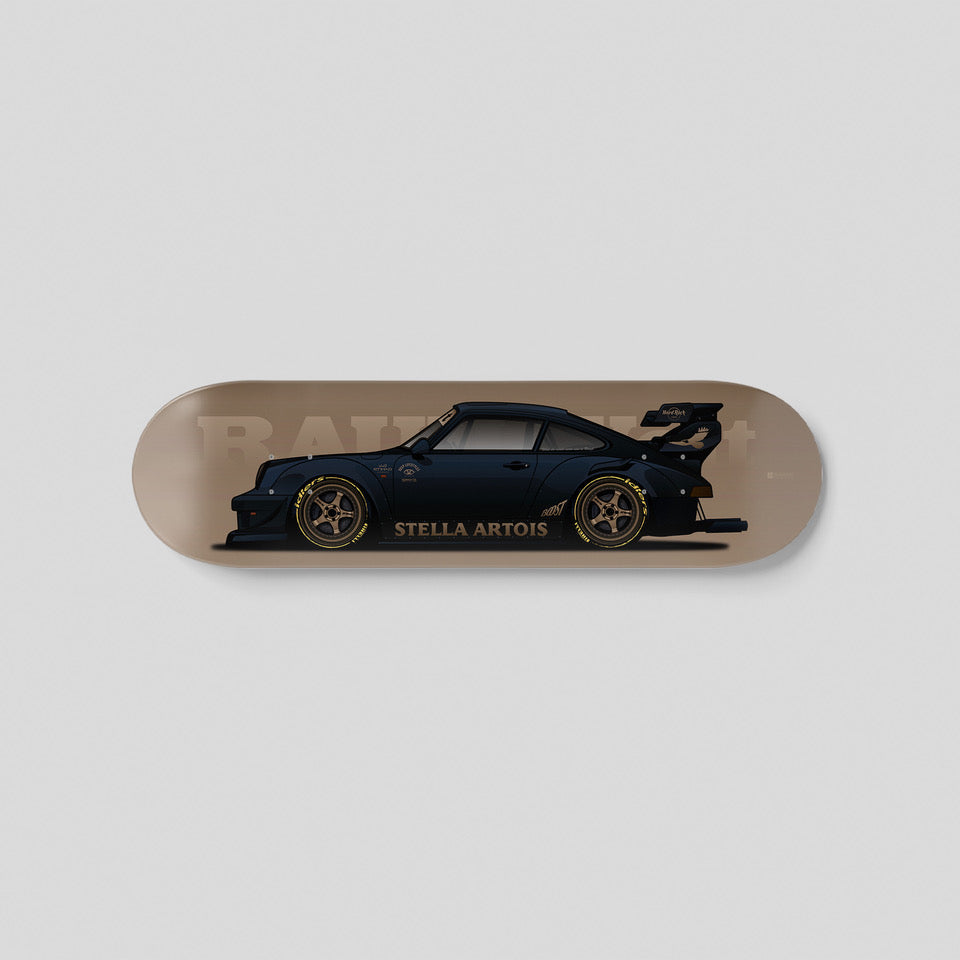
In the late 1990s, Nakai was working at a Porsche specialty body shop in Japan when a damaged 1985 Porsche 930 arrived. He decided to build it into the car he had always imagined: low, wide, with overfenders that changed the 911's proportions completely. He stripped the interior, fitted a 3.8-litre naturally aspirated flat-six with PMO carburettors, and built a widebody kit by hand. He named the car Stella Artois. It was the first RWB.
People noticed. Requests followed. Nakai opened his shop (Rauh-Welt Begriff) in Kashiwa, just northeast of Tokyo, and started building cars for customers. The early builds set time attack records at circuits across Japan. Multiple RWB cars won at the Idlers 12-hour race at Twin Ring Motegi. The cars were not just for looking at.
The method
What makes RWB unlike any other tuning operation is the process. Nakai flies to wherever the car is. He works alone, typically over several days. He cuts the original fenders with an angle grinder (a permanent, irreversible modification) and rivets on hand-shaped fibreglass overfenders. There are no templates. Each build is different because each car is different and each customer is different. The proportions are worked out by eye, adjusted until they look right to Nakai, and then committed to.
The result is a car that sits dramatically lower and wider than the original, with a visual presence that is immediately recognisable as RWB regardless of the specific colour or specification. The wide overfenders, the deep-dish wheels, the aggressive front splitter and rear wing: these are the consistent elements. Everything else varies.
Each car receives a name before Nakai leaves. The names are personal to the owner or to Nakai's own associations with the build. Stella Artois, Rotana, Pandora One, Tsubaki, Tsubasa: the naming convention is part of the RWB identity. A car with a name is a specific object, not a configuration. It cannot be replicated.

Nakai has stated his philosophy directly: "My goal is to make cars that not only look cool, but that you can drive. Cars that don't just sit on display." The builds that set lap records at Motegi were not show cars. They were track weapons wearing widebody kits.
Why the 964
The vast majority of RWB builds are based on air-cooled 911s, and the 964 is the generation most closely associated with the brand. The 964 ran from 1989 to 1994, the last generation of 911 to use the traditional torsion bar rear suspension before the 993 introduced the more modern multi-link setup. It shares the classic 911 silhouette that has defined the car since 1963, but with updated bumpers and a cleaner overall shape that suits RWB's widebody treatment particularly well.
The 964 is also the generation that sits at the right intersection of availability and desirability. Early air-cooled 911s are now prohibitively expensive as collector pieces. The water-cooled cars from the 996 onwards carry different cultural associations. The 964 and 993 occupy a sweet spot: recognisably classic, mechanically robust, and available in sufficient numbers that committed owners are prepared to modify them permanently.
RWB has built on 993s, 997s and 991s as well, but the 964 is the canonical RWB generation. When people picture a Rauh-Welt Porsche, they picture a 964.
The Stella livery
Among all RWB builds, Stella Artois, Nakai's personal car and the first RWB ever built, occupies a specific place. The car has appeared at events across Japan and internationally, and its livery has become one of the most referenced in Japanese car culture. The combination of the RWB widebody treatment on the original 930 body, the specific wheel choice, and the low stance that Nakai established for his own car created the template that every subsequent RWB has referenced in some way.

The Deckorate RWB Stella livery deck captures that specific car: the build that started everything, the reference point for a global community of Porsche enthusiasts who have followed Nakai's work for decades.
RWB worldwide
The global expansion of RWB began as Nakai started travelling to build cars for international customers. He has built in the United States, Europe, the Middle East, Southeast Asia and Australia. Each build is still done by hand, alone, with the same tools and the same method. The only difference is the flight. There are now several hundred RWB builds in existence worldwide. Each one is unique. None can be ordered through a catalogue or replicated from a template.
The community that has developed around RWB builds is significant. Annual gatherings bring owners together at circuits across Japan and internationally. The social media presence of individual RWB cars (each with their own name and history) has created a culture of documentation and appreciation that extends well beyond the Porsche community into broader car culture.
Porsche purists remain divided on RWB. The irreversible modification of classic air-cooled 911s is genuinely controversial among collectors who consider those cars significant objects that should be preserved in original condition. Nakai has never engaged with this argument. He builds what he believes in and names each car before he leaves.
On your wall
The Deckorate RWB collection covers three expressions of Nakai's work on the 964 platform.
The two 964 RWB 3-packs each present three different builds showing the range of colour, wheel choice and specification that RWB achieves on the same base car. The Stella livery deck covers the original: the car that started the whole thing in Nakai's shop in Kashiwa in the late 1990s.

For anyone who follows the RWB community, or who considers the widebody air-cooled 911 the definitive expression of what a Porsche can become in the right hands, these are the decks.
Shop the Porsche 964 RWB 3-pack Series 2 →
Shop the Porsche 964 RWB 3-pack →