The Nissan Skyline GT-R R34 was built from 1999 to 2002. Only around 11,000 were ever made. For most of that production run it was completely unavailable in the United States due to import restrictions. It appeared in two Fast and Furious films, in every Gran Turismo of its era, and became the car that an entire generation of car enthusiasts built their obsession around. Clean examples that sold for $30,000 in 2015 now change hands for $150,000 or more. This is the full story of how that happened.
The R34 is part of the Deckorate JDM collection alongside the Toyota Supra MK4, the Hakosuka and the Mazda 787B. For the full JDM story, read our JDM wall art guide.
The lineage: what came before
The GT-R nameplate has existed since 1969, when the original Skyline GT-R won 50 consecutive races in Japanese touring car competition. After a long hiatus, Nissan revived it in 1989 with the R32 GT-R, the car that earned the Godzilla nickname by demolishing the Australian Touring Car Championship against purpose-built racing machinery. The R32 won every race it entered in its first season. The R33 followed in 1995, slightly larger and heavier but technically more advanced.
The R34 launched in 1998 as the successor to the R33. Nissan shortened the wheelbase significantly, returning some of the agility that fans felt the R33 had sacrificed. The powertrain carried over from the previous generation, but the chassis was stiffer, the aerodynamics were more developed, and the electronics were more sophisticated. A brand new multifunction display in the centre console could show live telemetry data from the car's various systems, an unusual feature for a road car in 1999 that has since become standard across the industry.
The RB26DETT
The engine is the reason everything else exists. The RB26DETT is a 2.6-litre twin-turbocharged inline-six with a closed-deck iron block, forged internals, and twin ceramic turbochargers. Nissan officially rated it at 276 horsepower across all R32, R33 and R34 GT-Rs: a figure dictated by Japan's informal gentleman's agreement between manufacturers to cap power outputs at 276 hp to avoid a performance arms race on public roads.
The actual output was considerably higher. Independent dyno testing consistently showed R34 GT-Rs producing 320 horsepower or more in standard form. The N1 competition variants with larger steel turbochargers produced closer to 400 horsepower on the same official rating. Nissan knew, the tuning community knew, and everyone agreed to maintain the fiction.
What made the RB26DETT genuinely legendary was its tuning potential. The closed-deck iron block could handle enormous increases in boost without requiring internal modifications. With upgraded turbochargers and supporting fuel and management changes, standard RB26DETT blocks routinely produced 500 to 600 horsepower. The N1 competition block has been pushed to over 700 horsepower. No other engine in JDM history has combined factory reliability with this degree of aftermarket potential so consistently.
ATTESA and the technology
The R34's all-wheel drive system, ATTESA E-TS, defaults to rear-wheel drive under normal conditions and can transfer up to 50% of torque to the front wheels within milliseconds when the electronics detect wheel slip, steering angle, throttle position, yaw rate or lateral g-force that suggests the rear wheels are losing traction. The transition is imperceptible in normal driving and instantaneous under hard acceleration.
The V-Spec variants added an active limited-slip differential at the rear, controlled by the same electronics package. Super HICAS four-wheel steering was standard across the GT-R range. The combination of ATTESA, the active LSD and Super HICAS made the R34 one of the most technologically advanced production cars available in 1999 at any price point.
The variants
Nissan produced several versions of the R34 GT-R across its four-year production run.
The standard GT-R was the base model. The V-Spec added the active LSD and larger Brembo brakes. The V-Spec II replaced it in 2000, adding a carbon fibre bonnet with NACA ducts and stiffer suspension settings.
The N1 was the homologation special, built to qualify the GT-R for Group N motorsport. It came with the N1 engine block and steel turbochargers, no air conditioning, no rear wiper, no boot trim, no carpet and no radio. Only 45 were built. Twelve went directly to Nissan's racing programme.
The final variants were the V-Spec II Nür and M-Spec Nür, produced in the final months of R34 production in 2002 as a farewell to the RB26DETT engine, which stricter emissions regulations were about to make unviable. The Nür suffix referenced the Nürburgring Nordschleife, where the car had undergone extensive development testing.
The Fast and Furious connection
The R34 appeared across two Fast and Furious films, and the details matter because both versions of the car have become part of the collection's mythology in their own right.
2 Fast 2 Furious (2003). Brian O'Conner's R34 in this film wears what is officially Platinum Metallic paint (silver with a blue iridescent quality) with blue racing stripes. Despite the official colour, the car became known and remembered as "the blue Skyline." Brian uses it for the legendary bridge jump and the street race sequences. The silver and blue combination with the aggressive aerodynamic kit and the characteristic R34 quad circular taillights created the definitive visual impression of the car for a generation of American audiences who could not legally own one. The car is paired with a Mitsubishi Lancer Evo VII in those same Miami street sequences.
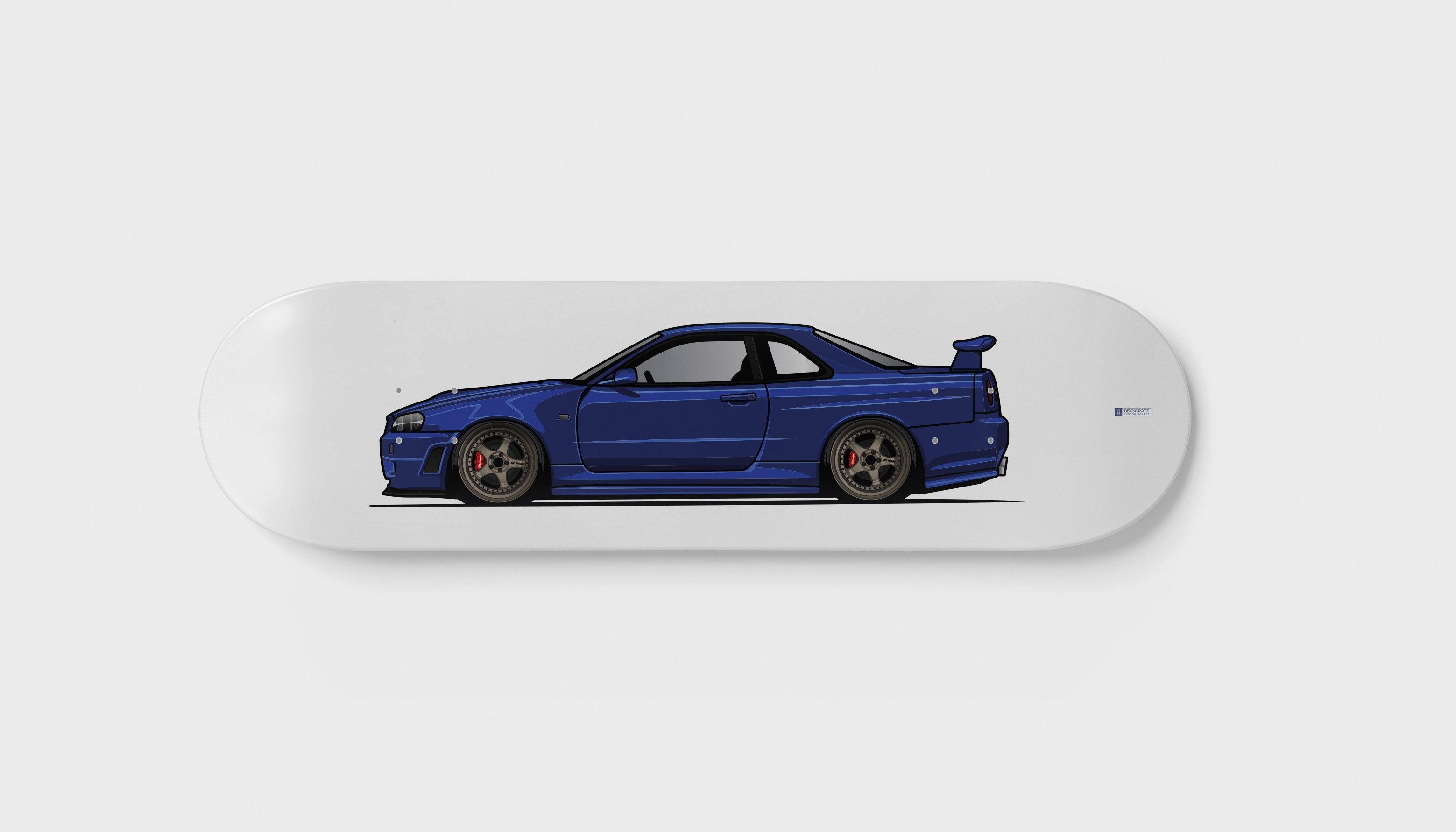
Fast and Furious 4 (2009). Brian drives a genuine Bayside Blue R34 GT-R, assembled from parts of multiple vehicles to infiltrate Arturo Braga's drug cartel. Bayside Blue is the pure, vibrant blue colour that Nissan applied to a portion of R34 production and is the colour that R34 collectors most consistently seek out today.
The Deckorate collection covers both. The Bayside Blue R34 is available as a standalone deck. The Miami Streets 2-pack covers the 2 Fast 2 Furious tribute: the silver and blue R34 alongside the Mitsubishi Lancer Evo VII, the two cars from that film's most memorable sequences.

Shop the Miami Streets 2-pack (R34 + Evo VII) →
The import ban and the forbidden fruit effect
The United States has a 25-year import rule for vehicles that do not meet federal safety and emissions standards. The R34 GT-R went on sale in Japan in 1999. American buyers could not legally import one until 2024.
This restriction created an entire mythology around the car in the United States. It appeared in two Fast and Furious films and in every major racing video game of the era. American enthusiasts could see it, drive it in Gran Turismo, and want it. They simply could not buy one. The combination of genuine mechanical excellence and legal inaccessibility produced the kind of desire that straight availability never generates. By the time 25-year-old R34s began arriving in the US in 2024, the price had long since reflected the demand that had built up over two decades.
Values today
The R34 GT-R has followed a value trajectory that nobody predicted in the early 2010s. Cars that were available for under $30,000 as recently as 2015 now routinely sell for $100,000 to $150,000 in good condition. V-Spec II Nür examples with documented history command significantly more. The N1 homologation cars are in a different category entirely.
The reasons are straightforward: limited production numbers, the 25-year import rule creating pent-up American demand, the cultural status built over decades of film and gaming appearances, and the genuine mechanical excellence of a car that can still embarrass much more modern machinery with appropriate modifications.
On your wall
The Deckorate R34 collection covers the car across its two most iconic screen appearances.
The standalone Bayside Blue deck captures the pure colour that Brian drives in Fast and Furious 4: vivid, unmistakable, and the shade that R34 collectors seek above all others.
The Miami Streets 2-pack covers the 2 Fast 2 Furious tribute: the silver and blue R34 in Platinum Metallic alongside the Mitsubishi Lancer Evo VII, both from the sequences that gave a generation of American fans their first serious look at what a Skyline was.

Shop the Nissan Skyline GT-R R34 Bayside Blue deck →
Shop the Miami Streets 2-pack (R34 + Evo VII) →