Lancia Delta Integrale: The Most Successful Rally Car Ever Built
Between 1987 and 1992, the Lancia Delta Integrale won six consecutive World Rally Championship Manufacturers' titles. No car before it had won six in a row. No car since has matched it. Across those six seasons it accumulated 46 WRC victories, competed on every surface from Arctic ice to African dirt, and evolved through four distinct versions without ever losing the essential character that made it dominant. It is the most successful rally car in the history of the sport. This is the full story.
The Delta Integrale is part of the Deckorate rally collection alongside the Group B legends. For the full story of the era that preceded the Integrale's dominance, read our Group B rally guide.
Before the Integrale: the Group B era and what came after
To understand the Delta Integrale, you need to understand what it replaced. Group B rally cars were the most extreme machines ever built for stage rallying: mid-engined, turbocharged, producing 400 to 600 horsepower in cars weighing under 900 kg, running on public roads with spectators standing metres from the cars at speeds exceeding 200 km/h. The Lancia Delta S4 was among the most fearsome of them.
Group B ended after the 1986 season following a series of fatal accidents, most notably Henri Toivonen's crash on the Tour de Corse. The FIA replaced it with Group A regulations, which required manufacturers to use production-based cars with significantly less power and more road-relevant technology. The intention was safety. The unintended consequence was that the manufacturer best placed to exploit the new rules would dominate the championship for years.
That manufacturer was Lancia. Their existing Delta 4WD road car was already better suited to Group A competition than anything their rivals had in production. The Delta HF 4WD won on its debut at the 1987 Monte Carlo Rally. By the end of that season Lancia had the Manufacturers' title. The six-year run had begun.
The evolution: four cars, one dynasty
The Delta Integrale was not a single car. It was four successive evolutions of the same basic architecture, each one responding to the competition and to the regulations that attempted to slow it down.
The original HF Integrale arrived for 1987 with an 8-valve 2.0-litre turbocharged engine producing around 185 horsepower in road trim and significantly more in competition specification. Four-wheel drive was standard. The wider bodywork that would define the car's visual identity was introduced at this point, accommodating the wider track needed for performance at the front and rear axles.
The Integrale 16V followed in 1989, adding a new sixteen-valve cylinder head that raised power output considerably. The 16V won both the Manufacturers' and Drivers' championships in 1989, with Miki Biasion taking his second consecutive Drivers' title. It was faster, more reliable, and more consistent than the 8V it replaced.
The Evoluzione arrived in 1991 with revised engine management, improved turbocharger efficiency and aerodynamic refinements including a more prominent front spoiler. Juha Kankkunen won the Drivers' title that year, his second with Lancia.
The Evoluzione II completed the dynasty in 1992. Carlos Sainz, driving for Lancia in his final season with the team before moving to Toyota, won the Drivers' Championship. Lancia secured their sixth consecutive Manufacturers' title. Then they withdrew from the WRC entirely, ending the most sustained period of dominance any single car has produced in the sport's history.
The drivers
The Integrale's success was built on a succession of world-class drivers who each left their mark on the car's legacy.
Juha Kankkunen was the Finn whose combination of speed and mechanical sympathy made him the ideal Integrale driver. He won the Drivers' Championship in 1987 in the first season of the car's existence, and again in 1991 in the Evoluzione. His ability to read road surfaces and manage tyre wear over a full rally stage gave Lancia a consistency advantage that outlasted the car's outright pace advantage as the competition developed.
Miki Biasion won back-to-back Drivers' titles in 1988 and 1989, becoming the first driver to win consecutive world championships since Walter Rohrl in 1980 and 1982. The Italian's aggressive style suited the Integrale's four-wheel drive character and his home advantage on Italian asphalt stages produced some of the most dominant individual rally performances of the era.
Didier Auriol contributed multiple victories through the early 1990s and would go on to win the Drivers' Championship in 1994 with Toyota after leaving Lancia. His presence in the Integrale through 1991 and 1992 gave Lancia a third front-running option that made team tactics considerably more complex for the opposition to manage.
Why six championships in a row
The six-title run was not simply a matter of having the fastest car. Other manufacturers had competitive machinery at various points across the period. Toyota, Mitsubishi, Ford and Mazda all produced Group A cars that could win individual rallies. None of them could sustain a challenge across a full season against Lancia's combination of car performance, driver quality and team organisation.
The Integrale's key technical advantage was its four-wheel drive system, which was more sophisticated and better integrated with the car's overall handling balance than anything the competition fielded in the early years of Group A. On loose surfaces the traction advantage was decisive. On asphalt the combination of grip and balance allowed Lancia's drivers to use full power earlier out of corners than rear-wheel drive competitors could manage.
The team behind the car was Lancia Martini Racing, whose experience managing multiple-car entries across the era of Group B gave them an organisational depth that newer competitors could not match immediately. When conditions changed mid-rally, Lancia's ability to adapt strategy, tyre choice and set-up faster than the opposition was as important as any specific technical advantage the car held.
The road car
Unlike many homologation specials, the Lancia Delta Integrale was a genuinely desirable road car. The production versions carried the same visual identity as the competition cars: the wide bodywork, the prominent bonnet vents, the raised suspension stance. The road car produced 185 to 215 horsepower depending on variant, used the same four-wheel drive system as the rally car in modified form, and offered performance that was genuinely competitive with sports cars costing considerably more.
The Evoluzione II road car is now considered one of the great hot hatches of any era. Its combination of all-weather capability, driver involvement and motorsport provenance has made clean examples increasingly valuable. Cars that sold for modest money in the late 1990s now command prices that reflect their historical significance. The connection between the road car and the championship-winning rally car was always direct and visible, and that connection is what the collector market has been valuing ever since.
The legacy
The Integrale's six consecutive championships set a record that remains unbroken. Every manufacturer that has attempted a sustained WRC campaign since has been measured against what Lancia achieved between 1987 and 1992. Subaru, Toyota, Mitsubishi and Volkswagen have all won multiple consecutive titles in subsequent eras. None has reached six.
Lancia's withdrawal from the WRC after 1992 means the Integrale ended its competitive career at the peak of its development. It was not replaced by a successor. It was simply retired. The Evoluzione II that won the 1992 title was the last WRC car Lancia ever built. The brand's motorsport history ended with the most successful rally car the sport has ever produced, at the moment of its sixth consecutive championship.
That is an ending very few cars in any motorsport category have been given.
On your wall
The Deckorate Lancia Delta Integrale collection covers three expressions of the car across its championship-winning era.
The yellow Integrale captures the road car in its most recognisable specification: the wide arches, the bonnet vents, and the stance that made it immediately identifiable as something more than a standard hatchback.

Shop the Lancia Delta Integrale yellow deck →
The British Racing Green variant covers the Integrale in the colour most associated with the road car's collector market: understated, purposeful, and entirely correct on the wide-body Evoluzione silhouette.

Shop the Lancia Delta Integrale green deck →
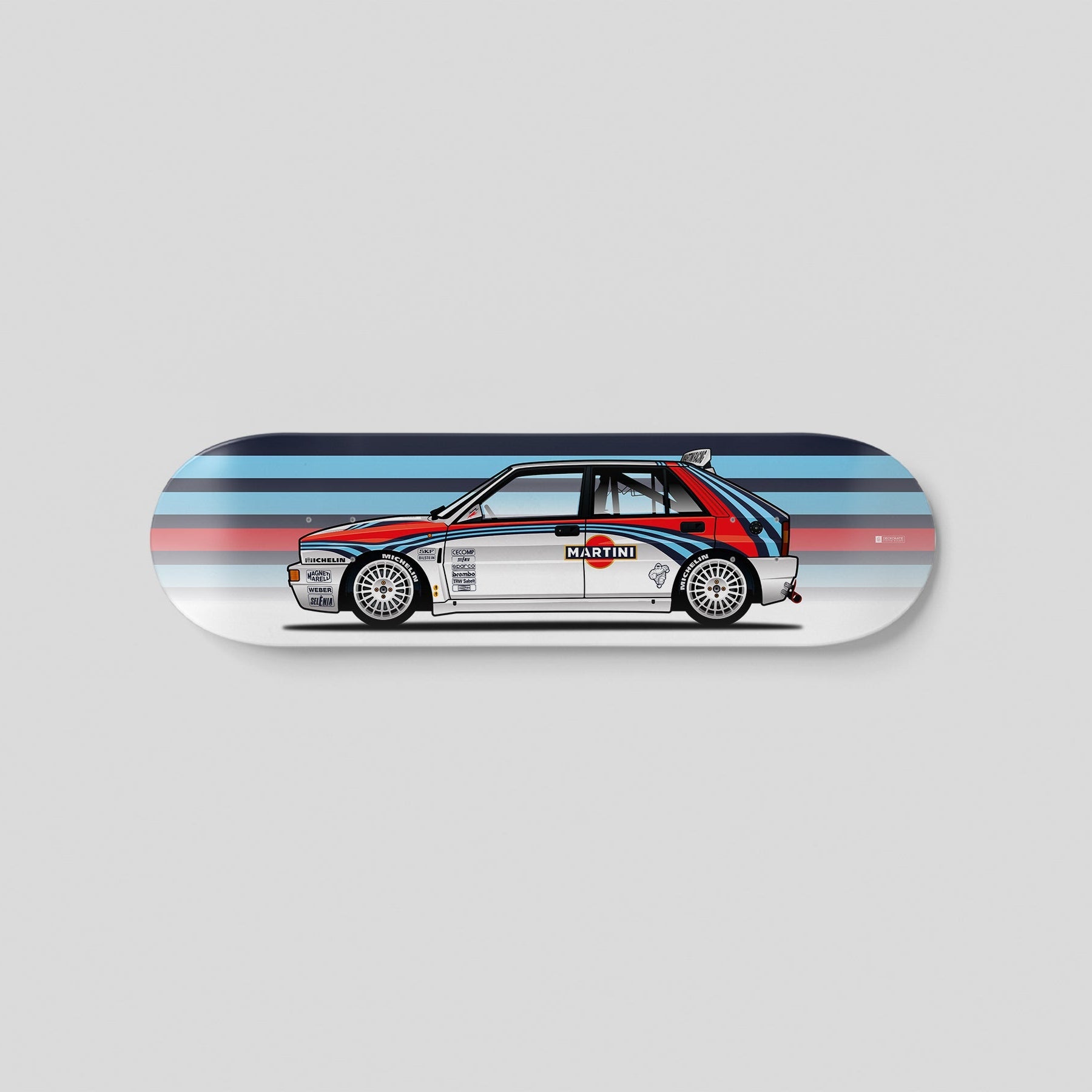
The Martini livery deck covers the Evoluzione in the white, red and blue Martini Racing colours that defined Lancia's WRC identity across the six-title dynasty. The most historically significant livery of the three.

Shop the Lancia Delta Integrale Martini deck →