Four years. Twelve rallies per season. Five manufacturers. And the most terrifying, spectacular, ungovernable racing cars ever built. Group B was the golden age of rallying, and it ended in fire on a mountain road in Corsica on a Thursday afternoon in May 1986. Forty years later, nobody who witnessed it has forgotten a second of it.
This is the full story of Group B. The technology that made it extraordinary. The cars that defined it. The accidents that ended it. And why, three decades after the ban, these machines are still the most revered things ever to turn a wheel in the dirt.
How it started: the loophole that launched a monster
Before 1982, World Rally Championship cars competed under Group 4 regulations. They were fast, Lancia Stratoses, Fiat 131s, early Audi Quattros, but they were still fundamentally derived from production cars, subject to strict limits on weight, engine size, and minimum production numbers. The racing was good. The cars were impressive. But nobody called it a golden age.
Then the FIA introduced Group B.
The intent was to attract more manufacturers to the sport by lowering the barrier to entry. Under previous rules, a manufacturer needed to produce at least 400 road-legal versions of their competition car to qualify for homologation. Group B cut that number to just 200. Two hundred cars. That was all it took to unleash whatever you wanted on the world's rally stages.
There were almost no restrictions on technology. No limits on turbo boost. No meaningful limits on power. No requirements on the relationship between the road car and the race car,manufacturers could build a silhouette car that shared nothing but a vague body shape with the production model, produce 200 examples, and call it road legal. Group B cars initially produced about 300 horsepower. Soon that number rose to 400, and then 500.
The engineers went to work. And what they built changed everything.
The cars: a brief tour through organised madness
Audi Sport Quattro S1 - the pioneer that started a war
Audi arrived first and arrived loudest. The original Quattro had introduced all-wheel drive to rallying in 1981, and the technology was immediately, obviously superior on the mixed surfaces of a WRC stage. By the time Group B came along, Audi had been refining that system for two years. The Sport Quattro S1, and its final E2 evolution, was the most developed expression of what that knowledge could produce.

Audi's Sport Quattro S1 boasted over 600 hp and a huge snowplow-like front end. The bodywork looked like it had been designed by an aircraft engineer who had never seen a car before, massive vents, enormous wings, a whale-tail rear spoiler that generated real downforce on gravel stages. The S1 could accelerate from 0–60 mph in just 2.8 seconds, performance that rivals modern supercars. This was on gravel, in the mountains, in the 1980s.
Walter Röhrl and Michele Mouton drove the S1 to multiple victories. Röhrl, in particular, was considered by many to be the only driver in the field who could fully exploit what the car was capable of, and even he admitted the S1 operated near the edge of what a human being could control.
Peugeot 205 T16 - l'enfant terrible
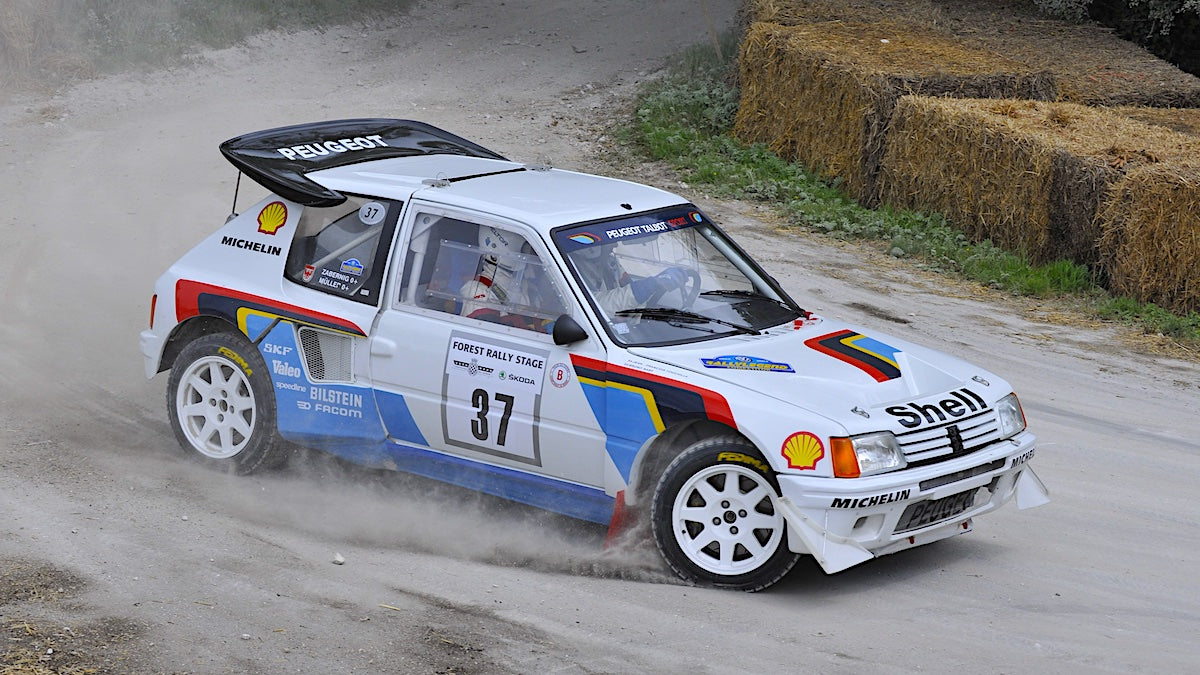
The Peugeot 205 T16 looked like a standard 205 hatchback that had been catastrophically modified by someone with access to a race shop budget and no sense of restraint. The body was widened. The engine was moved to the middle. The rear seats were removed to make space for a turbocharged 1.8-litre engine producing around 450 horsepower in its final Evolution 2 form. The only things the T16 shared with a road 205 were the headlights, the radiator grille, the windscreen, the rear lights, and the door handles. Everything else was purpose-built.

It was also, in the final accounting, the most successful Group B car ever raced. The Peugeot 205 T16 took full advantage of Group B's regulations and was technically the era's most successful car with 16 overall victories and two World Championships to its credit. Jean Todt, later Ferrari's team principal, later FIA President, ran the Peugeot programme. Ari Vatanen and Timo Salonen drove it to titles. The T16 then went on to win Pikes Peak and dominate the Paris-Dakar. In any other era, it would have been the greatest rally car ever built. In Group B, it was just the most successful of several extraordinary machines.
Lancia Delta S4 - the most extreme thing Abarth ever made
Lancia's answer to the mid-engine AWD revolution was the Delta S4, a car that shared a name and a body shape with the standard Delta production hatchback and absolutely nothing else. Underneath the detachable two-piece composite bodywork was a tubular spaceframe chassis, double wishbone suspension at both ends, a three-differential AWD system, and an engine that was, by any reasonable standard, completely insane.
The car's 1,759cc engine combined supercharging and turbocharging to reduce turbo lag at low engine speeds, the first compound charged engine ever raced. Officially the car produced 550 horsepower. Unofficially, with the boost turned up for certain stages, it was considerably more. Lancia team boss Cesare Fiorio later claimed that Toivonen was the only driver who could really control the Delta S4.
The S4 won on its debut, the 1985 RAC Rally, in Toivonen's hands. It won the Monte Carlo in 1986. It was probably the fastest car in the field in that final season. And then, in May 1986, it became the car that ended Group B altogether.
Ford RS200 - the car that arrived one season too late
Ford's RS200 was, by conventional standards, an extraordinary piece of engineering. A purpose-built mid-engine 4WD supercar, it produced around 450 horsepower in competition trim, with rumours of 600hp versions being prepared for 1987. Its transmission was mounted at the front to achieve a perfect 50/50 weight distribution. It looked aggressive and purposeful in a way that even the Peugeot and Lancia couldn't quite match.
The problem was timing. Ford only ran the RS200 in competition for one full season before Group B was banned. Ford had planned to introduce an 800hp Evolution model for the 1987 season, we never got to see it. The RS200 that Joaquim Santos was driving at the 1986 Rally de Portugal, however, was not a story about performance. It was the beginning of the end.
The crowds: a disaster waiting to happen
Understanding why Group B ended requires understanding what the stages looked like in the early 1980s.
Rally had always been a sport where spectators stood close to the cars. Too close. The stages ran through forests, up mountain passes, along cliff edges and through villages. There were no barriers. There was minimal marshal presence on remote sections. And as the Group B cars became faster and more spectacular, fire-spitting turbos, enormous jumps, car-width powerslides through forest roads, the crowds grew. Then they grew more. Then they grew beyond any possibility of control.
In the days before the internet and comprehensive television coverage, millions of spectators flocked to the rally stages. Watching, smelling, and hearing these monsters in action was not only an occasion, it was a religious experience for millions of fans around the world. At some European rallies, with thousands of spectators lining the stages, adventurous youngsters played a dangerous game, standing inside corners, leaning over crests, reaching out to touch moving cars.
The drivers knew it was dangerous. The team managers knew it. The FIA knew it. But the sport was booming, the manufacturers were spending fortunes, and nobody wanted to be the one to slow it down.
Then Portugal happened.
Portugal, 1986: the point of no return
5 March 1986. Stage 14 of the Rally de Portugal, near Sintra. Joaquim Santos crested a rise in his Ford RS200 and found a crowd of spectators standing in the road. He swerved to avoid them, and lost control.
The car veered to the right and slid off the road into another group of spectators. Thirty-one people were injured and three were killed. Two children and a woman died at the scene. A fourth child died in hospital shortly afterwards.
The factory teams withdrew from the rally immediately. Audi announced they would not start another Group B event. The drivers, men who had been risking their own lives every weekend without complaint, refused to continue racing past spectators who had no protection from 500-horsepower cars travelling at speeds that left no margin for error. The writing was on the wall.
The FIA announced that Group B would be banned from the end of the 1986 season. But the season wasn't over. And the worst was still to come.
Corsica, May 1986: the corner that ended everything
Henri Toivonen was 29 years old. He had won three WRC rallies, accumulated 185 stage wins, and was, by common consensus among his peers, the most naturally talented driver of his generation. He had won the 1986 Monte Carlo in the Delta S4 in weather so bad the other factory teams had considered withdrawing. His co-driver, Sergio Cresto, was 36.
On 2 May 1986, on Stage 18 of the Tour de Corse, the Rally of 10,000 Corners, Toivonen's Delta S4 left the road on a left-hander near Corte and plunged down a ravine.
The aluminium fuel tank underneath the driver's seat was ruptured by the trees and exploded. Toivonen and Cresto had no time to get out and both men burned to death in their seats. The accident had no witnesses close enough to clearly see what happened.
Within hours of the accident, the FISA banned Group B cars from competing in the 1987 season. Audi and Ford withdrew immediately, and the remaining manufacturers mothballed their cars at the end of the season. An FISA investigation subsequently determined that the human brain couldn't keep up with the speed of the Group B cars, causing tunnel vision. The cars had become faster than the human nervous system could reliably manage.
Group B was over. It had lasted four seasons.
What came after: Group A and the long shadow
The FIA replaced Group B with Group A, production-based cars with engine limits of 2,000cc and a maximum of around 300 horsepower. The contrast was brutal. The Subaru Imprezas and Mitsubishi Lancers of the 1990s were brilliant rally cars, and their era produced its own legends. But they were, by Group B standards, machines from a different, slower universe.
The Group B cars themselves found a brief afterlife in European rallycross, where they competed on shorter mixed-surface circuits until being phased out in the early 1990s. Then they became museum pieces. Then they became auction lots that exceeded a million euros. A 1985 Lancia Delta S4 Group B works car, the last WRC winner for Toivonen, sold at RM Sotheby's for $2,218,885.
The cars that nobody wanted when they were new are now among the most valuable motorsport artefacts on the planet.
Why Group B still matters
Four years. A handful of manufacturers. A few dozen works drivers. A regulation that nobody fully understood the consequences of until those consequences arrived.
Group B matters because it represents something that motorsport has never managed to recreate and probably never will: a moment when the technology was running ahead of every other consideration. Ahead of safety. Ahead of common sense. Ahead of the FIA's ability to regulate it. The engineers were doing things that had never been done, twincharging an engine, fitting a Formula 1 anti-lag system to a rally car, building a 500-horsepower machine on a 960kg chassis, and doing them in real competition, on public roads, in the mountains, in front of hundreds of thousands of unprotected spectators.
It was reckless. It was magnificent. It was the most spectacular thing motorsport has ever produced, and it paid for its own spectacle in lives.
Forty years later, when you see a Lancia Delta S4 in a photograph, Martini livery, massive rear wing, all four wheels off the ground on a forest stage in Finland, you understand immediately why fans still talk about this era the way they do. There has never been anything like it. There will never be anything like it again.
That's what makes it worth remembering. That's what makes it worth putting on your wall.
The Deckorate rally collection includes the Lancia Delta S4 and Audi Quattro, the cars that defined the Group B era. Explore the Rally Legends collection →