Toyota Supra MK4: The 2JZ Story and Why the Orange Supra Changed Everything
Toyota launched the Supra MK4 in 1993, priced it above a Porsche 911 in some markets, and sold so few that production ended in 2002 as a commercial failure. Then a film called The Fast and the Furious featured an orange one in 2001, and everything changed. Today a clean manual twin-turbo example sells for $150,000 to $200,000. The car that Toyota couldn't give away is now one of the most valuable Japanese sports cars ever built. This is the full story.
The Supra is part of the Deckorate JDM collection alongside the Nissan Skyline R34 GT-R, the Hakosuka and the Mazda 787B. For the full JDM story, read our JDM wall art guide.
What the MK4 was built to do
The A80 Supra was Toyota's attempt to build a world-class sports car from first principles. Not a refined grand tourer, not a lightweight roadster: a proper performance car that could compete with the best European and Japanese alternatives at the time. The design team benchmarked it against the Porsche 911, the Ferrari 348 and the Nissan Skyline GT-R. The brief was to beat all three.
The car launched in Japan in 1993 and in the United States in 1994. In twin-turbo specification it produced 320 horsepower in the US market, with the Japanese domestic market version officially rated at 280 hp due to the same gentleman's agreement that governed the Skyline's stated output. The 0-100 km/h time was under five seconds. The top speed was electronically limited to 250 km/h. Contemporary road tests described it as one of the fastest cars in the world at any price.
It was also, by the standards of the mid-1990s, extremely expensive. In the United States the twin-turbo manual version carried a list price of around $40,000, which put it directly against the Porsche 911. Toyota was aware that the pricing was aggressive and sold the car at a loss for much of its production run, subsidising it as a halo product for the brand rather than a profit centre.
The 2JZ-GTE
The engine is the reason the Supra MK4 is still discussed thirty years after production ended. The 2JZ-GTE is a 3.0-litre twin-turbocharged inline-six with dual overhead camshafts, four valves per cylinder, sequential turbochargers, and most critically a cast-iron block with forged internals that Toyota over-engineered far beyond what the car's official specifications required.
The factory specification was 320 horsepower in US trim. The engine was designed to handle considerably more without modification. The closed-deck iron block, the forged connecting rods and pistons, and the robust bottom end meant that the 2JZ-GTE could absorb significantly increased boost pressure without the internal components failing. With upgraded turbochargers, fuel injectors and engine management, standard 2JZ-GTE engines routinely produce 600 to 800 horsepower. Purpose-built competition examples have exceeded 1,500 horsepower on the same fundamental architecture.
No other road car engine of its era offered this combination of factory reliability and extreme tuning headroom. The RB26DETT in the Skyline GT-R was similarly capable, but the 2JZ's iron block proved even more robust under sustained high-boost use. The tuning community discovered this quickly, and the Supra's reputation as a platform became inseparable from the engine that powered it.
Commercial failure, cultural institution
Despite its engineering excellence, the Supra MK4 sold poorly throughout its production run. The mid-1990s were not a hospitable environment for expensive sports cars. Toyota's North American dealers struggled to move them. Production ended in 1998 for the US market, with Japanese domestic market production continuing until 2002. Total global production across all variants was under 30,000 units.
The combination of limited production and genuine performance created the conditions for collectability, but the timeline was slow. Through most of the late 1990s and early 2000s, used Supras were available for reasonable money and the tuning community bought them, modified them, and drove them hard. Many were destroyed on circuits or in street racing incidents. The overall numbers declined steadily.
Then came 2001.
The orange Supra
The Fast and the Furious featured an orange Toyota Supra MK4 driven by Brian O'Conner. The car arrives at the film's halfway point as a junkyard wreck and is rebuilt into a race weapon. Jesse's line on seeing the stripped 2JZ engine: "Two-jay-zee engine, no shit, this will decimate all." It entered the vocabulary of an entire generation of car enthusiasts and became one of the most quoted lines in the franchise's history.
The cultural impact was immediate and permanent. Young American car enthusiasts who had never heard of a Supra suddenly knew what a 2JZ was. The orange paint job became one of the most reproduced colour choices in automotive culture. The connection between the Supra and the idea of a car that could beat anything regardless of its appearance became the defining narrative of the JDM tuning scene in the early 2000s.
The orange Supra appears in the first film only. Brian drives different cars in subsequent instalments. But the first film's Supra established the template that the entire franchise built on: the idea that a modified Japanese car could defeat cars costing ten times as much. That idea is still the emotional core of the Fast and Furious franchise twenty-five years later.
Motorsport: the JGTC years
The Supra MK4's reputation extended well beyond street tuning. In the All-Japan Grand Touring Car Championship, the Supra competed in the GT500 class from 1995 onwards, winning multiple championships through the late 1990s. The Castrol TOM'S Toyota Supra, numbered 36 and wearing the distinctive white, red and gold Castrol livery, won the JGTC championship in 1997 and produced one of the most recognisable racing liveries in Japanese motorsport history.
The Supra also competed at the 24 Hours of Le Mans in 1995, finishing 14th overall. It was not competitive at the front of the Hypercar field, but its Le Mans entry added another layer to the car's motorsport credentials and demonstrated that Toyota was using the Supra platform seriously across multiple racing disciplines simultaneously.
Collector values today
The value trajectory of the Supra MK4 is one of the most dramatic in the JDM collector market. Cars that were available for under $20,000 through most of the 2000s have appreciated to the point where clean manual twin-turbo examples regularly sell for $150,000 to $200,000 at auction. Six-speed manual cars in original specification with low mileage command premiums at the upper end of that range.
The factors driving the appreciation are familiar: limited production numbers reduced further by decades of modification and racing use, the cultural status established by The Fast and the Furious, the genuine engineering excellence of the 2JZ platform, and the broader collector market enthusiasm for 1990s Japanese performance cars that has accelerated through the 2010s and 2020s.
The irony is complete. Toyota sold the Supra at a loss as a halo product and stopped making it because it couldn't turn a profit. The cars they gave up on are now worth five times a new GR Yaris.
On your wall
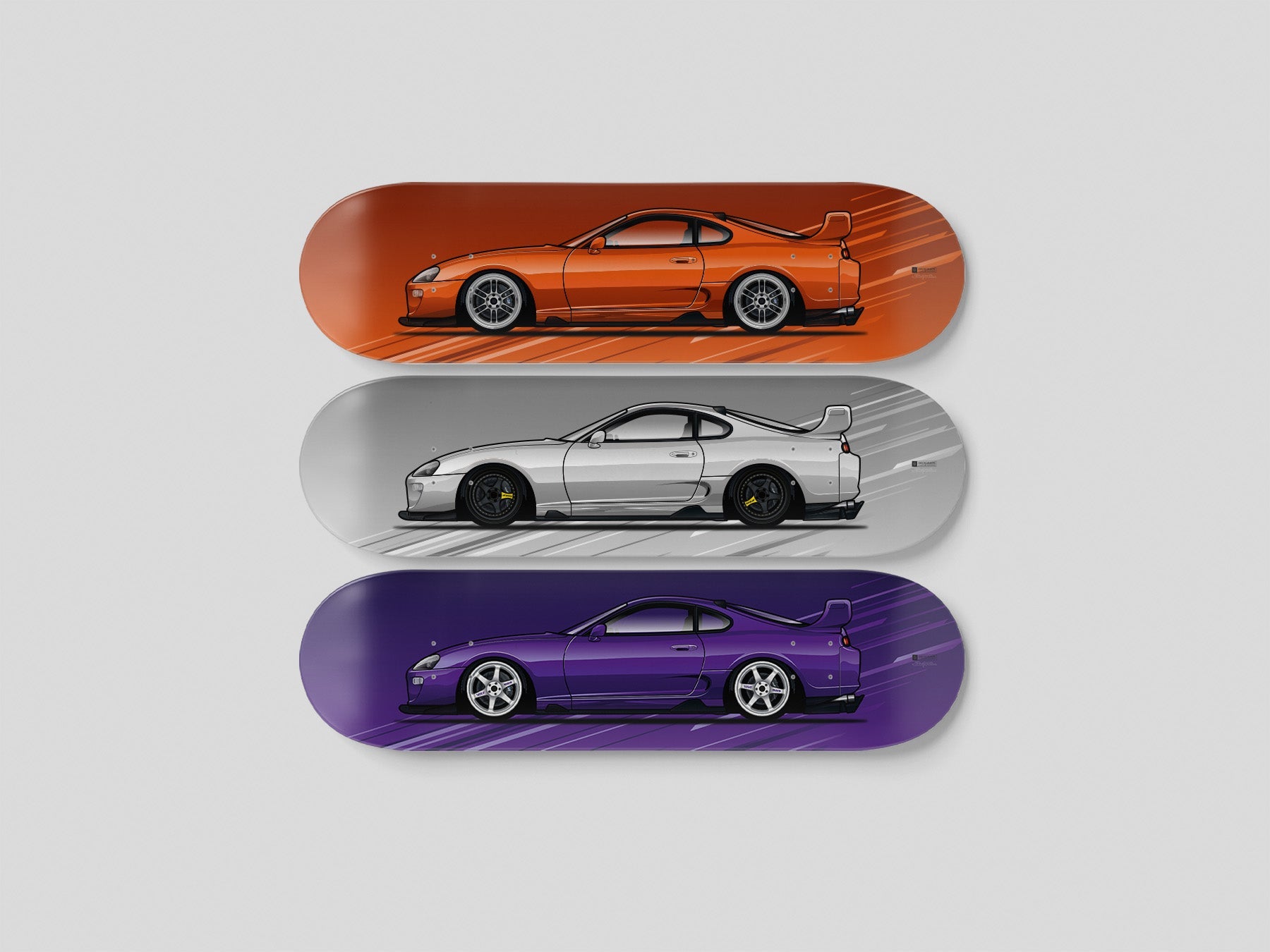
The Deckorate Supra MK4 collection covers three colourways, each capturing a different dimension of what the car represents.
The orange deck is the obvious starting point: the Fast and the Furious colour, the most referenced Supra in automotive culture, the car that changed JDM's global reputation in a two-hour film. The white deck captures the Supra in its cleanest, most timeless specification. The purple deck covers the drift and stance scene version of the car, the colourway that the tuning community adopted as its own.
The Supra 3-pack brings all three together, designed to be displayed as a set showing the full range of what the MK4 means across different audiences and different chapters of the car's cultural life.