Alfa Romeo 155 V6 Ti: The Italian That Humiliated Germany's DTM
In 1993 an Italian manufacturer entered the Deutsche Tourenwagen Meisterschaft for the first time and won 12 of 20 races. The championship went to Nicola Larini. The regulations were subsequently changed to reduce the car's advantage. It still won 11 races the following year. Over four seasons the Alfa Romeo 155 V6 Ti accumulated 38 championship victories and remains the only non-German manufacturer ever to win the DTM outright. This is its story.
The 155 V6 Ti is one of eight cars covered in our guide to the greatest DTM cars of the 1990s. For the full story of the car it displaced as the dominant force in the series, read our Mercedes 190 E 2.5-16 Evolution II deep dive.
The regulations that changed everything
The DTM's switch to FIA Class 1 regulations for the 1993 season was supposed to level the playing field. The new rules permitted 2.5-litre six-cylinder engines, advanced aerodynamics and four-wheel-drive systems. They also allowed a degree of engineering freedom that the existing manufacturers, running updated versions of their older cars, were not yet positioned to exploit.
Alfa Romeo was. The Italian manufacturer had been developing the 155 V6 Ti specifically for the new regulations, and arrived at the 1993 season opener at Zolder with a car that was categorically different from anything else on the grid. A naturally aspirated 2.5-litre V6 derived from the road car's Busso engine, producing 420 horsepower at an extraordinary 11,500 rpm. A four-wheel-drive system with a rear-biased torque split. A carbon-clad silhouette body that retained only the visual outline of the production 155. A car that weighed 1,100 kg and accelerated to 100 km/h in under three seconds.
Mercedes had the Evo II, which had dominated the previous era but was now running under regulations it had not been designed for. Alfa had built from scratch for exactly these rules. The gap was enormous.
1993: the most successful debut in DTM history
The 155 V6 Ti won on its debut at Zolder. Then it kept winning. By the end of the 1993 season, Nicola Larini had taken ten victories from twenty races, Alessandro Nannini had added two more, and Alfa Romeo had won the Drivers' and Manufacturers' championships in their first season of competition. Twelve wins from twenty races remains the most dominant debut season any manufacturer has produced in the history of the Deutsche Tourenwagen Meisterschaft.
Larini was a former Formula 1 driver who had competed with Ferrari, Ligier and Minardi across the late 1980s and early 1990s without ever finding machinery capable of showing what he could do. In the 155 V6 Ti, he found it. His 1993 season was a demonstration of what a driver of his calibre could achieve when given a genuinely superior car, and his composure under pressure over the course of a full season made the championship result feel inevitable long before it was mathematically confirmed.
Nannini's presence in the car carried its own story. In 1990, while an active Formula 1 driver with Benetton, he suffered a helicopter crash that severed his right forearm. Surgeons reattached it. He never returned to Formula 1, but in 1993 he was competitive enough in the 155 to win two DTM races and finish second in the championship. Few comebacks in motorsport history are as quietly extraordinary.
How the regulations responded
After 1993, the DTM's governing body revised the technical regulations with the specific intention of reducing the 155's advantage. The changes were targeted: adjustments to the aerodynamic package, modifications to the four-wheel-drive regulations, and various technical restrictions aimed at bringing the field closer together.
Alfa responded with upgrades. A new Kelsey-Hayes ABS system. Active suspension. A lighter engine configuration. Improved aerodynamics within the revised rules. The 1994 155 was a meaningfully better car than the 1993 version in most technical respects.
It still lost the championship. Klaus Ludwig, driving the new Mercedes-Benz C-Class that had been developed specifically as a Class 1 car from the outset, won the title through consistency rather than outright pace. Alfa won 11 of the 20 rounds in 1994. Ludwig won only three. But he accumulated enough points through podium finishes in the races he didn't win to take the championship, while Larini's five victories were not enough to overcome the deficit in points scored outside the top step.
The 1994 season is the most striking illustration of the difference between winning races and winning championships in a close field. Alfa were faster. Mercedes were more consistent. The championship went to Stuttgart.
1995 and 1996: the evolution continues
The 155 competed in 1995 as the DTM merged with the International Touring Car Championship, significantly expanding the calendar and the competition. Semi-automatic transmission, active differentials, double-wishbone rear suspension: the car continued to evolve with each season, becoming progressively more sophisticated and less related to the production car it nominally represented.
By 1996 the 155 V6 Ti had reached its final form. A new 90-degree V6 engine lowered the centre of gravity. Radical aerodynamic development including movable radiator shutters pushed the car to the edge of what the regulations permitted. In the second half of the 1996 season, after a difficult start, Alfa won eight of the final fourteen races. It was not enough to save the series. The ITC collapsed at the end of 1996 under the weight of its own costs, taking the 155 V6 Ti's competitive career with it.
The final record: 38 championship victories across four seasons. Seven different drivers contributed wins. Larini led the tally with 17, Nannini contributed 13. No other non-German manufacturer has won the DTM before or since.
What made it different
The 155 V6 Ti was not just faster than its competitors. It was conceptually different. Most of the cars it raced against were developed from existing platforms and adapted to the new regulations. Alfa built for the regulations from the start, with a philosophy that prioritised all-wheel drive traction and high-revving naturally aspirated power at a time when the opposition was still thinking in terms of rear-wheel drive and forced induction.
The sound is part of the legend. A 2.5-litre V6 at 11,500 rpm produces a noise that is unlike anything else in touring car history: high-pitched, mechanical, almost aggressive in its urgency. At full throttle through a fast corner the 155 V6 Ti sounded like it was trying to escape its own body. People who witnessed it at circuits across Germany and Belgium in 1993 still describe it as one of the most visceral experiences in motorsport.
It also looked right. The wide-body silhouette bodywork, the deep front splitter, the angular rear wing: the 155 V6 Ti looked like a race car that had been given a touring car's body as a formality, wearing the outline of the production 155 as a costume rather than a constraint. That visual identity, combined with the Italian red and white Alfa Corse livery, made it one of the most instantly recognisable cars of the DTM's golden era.
On your wall
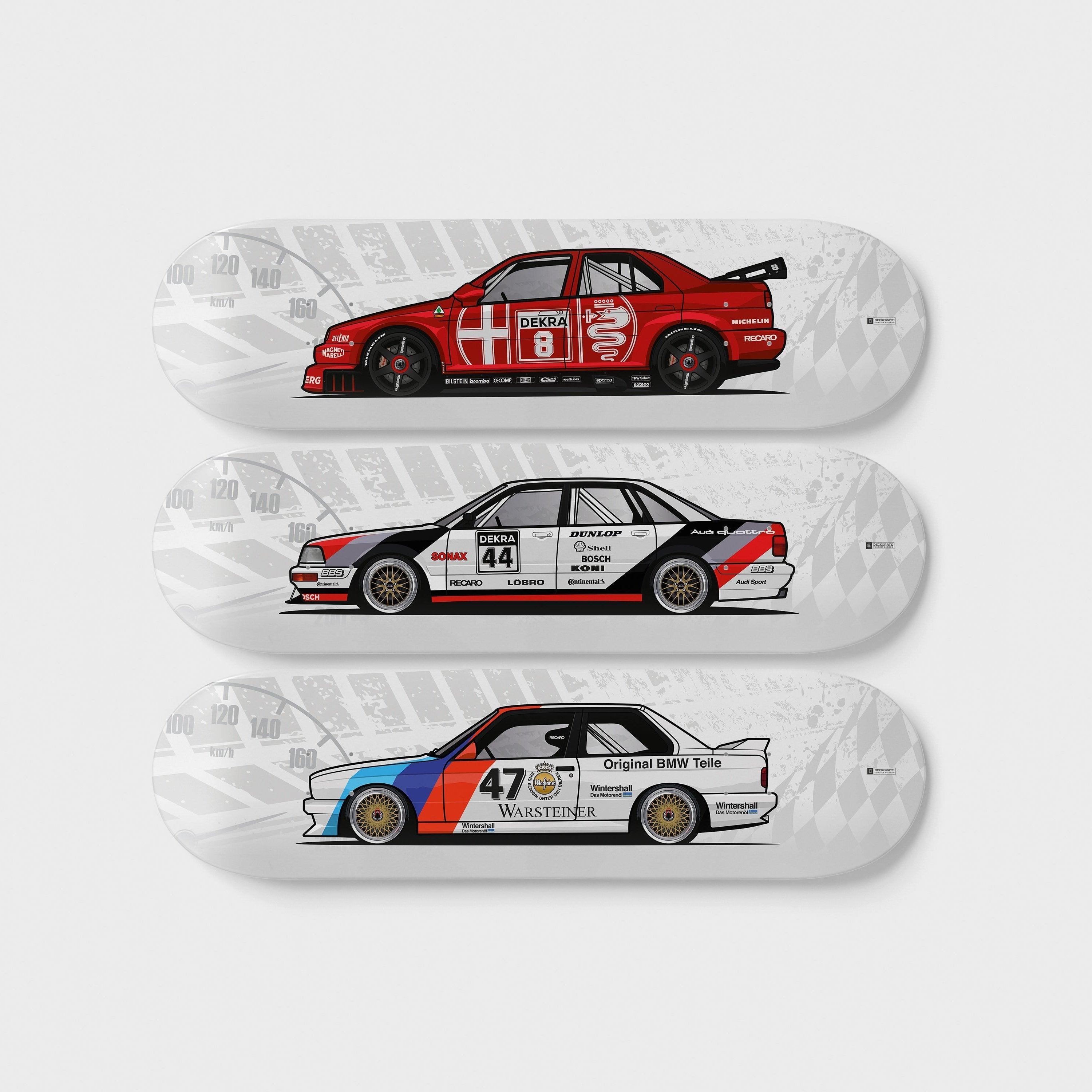
The Deckorate Alfa Romeo 155 V6 Ti deck captures the championship-winning car in the Alfa Corse livery from the 1993 and 1994 seasons: the red and white combination that became the visual signature of the only Italian manufacturer to have won the Deutsche Tourenwagen Meisterschaft.
For anyone who follows the DTM's golden era, the 155 V6 Ti sits alongside the Mercedes 190 Evo II and the BMW E30 M3 as one of the three cars that defined the period. The difference is that the Alfa arrived later, dominated immediately, and left on its own terms when the series it had helped define ceased to exist.
Shop the Alfa Romeo 155 V6 Ti deck →
Read: The 8 greatest DTM cars of the 1990s →