VW Golf MK1 GTI: The Secret Project That Created the Hot Hatch
In 1974 Volkswagen launched a small, practical hatchback to replace the Beetle. It was not supposed to be exciting. It was supposed to be rational, modern and fuel-efficient — exactly what the market wanted in the aftermath of the 1973 oil crisis. Two years later, a handful of engineers who had been quietly working on an unofficial side project launched the GTI. They planned to build 5,000 units to cover development costs. They ended up creating a new category of car that every manufacturer on earth has been chasing ever since.
This is part of our complete VW Golf guide covering every generation from MK1 to MK8.
Replacing the Beetle
The Volkswagen Beetle had been in continuous production since 1938. By the early 1970s it was visibly outdated: rear-engined, air-cooled, with a chassis that belonged to a different era. Volkswagen had made several attempts to find a successor, all of which had fallen short. The project that eventually became the Golf was codenamed Typ 17 and given to Giorgetto Giugiaro of the ItalDesign studio to style.
Giugiaro was at the peak of his powers. In the early 1970s he also designed the Lotus Esprit, the Alfasud and the BMW M1. His approach to the Golf was characterised by what he called his origami style: sharp corners, flat planes, and a disciplined restraint that prioritised functionality without sacrificing visual coherence. He would later describe the Golf MK1 as the pinnacle of his career. The result was a car that looked completely modern in 1974 and has aged remarkably well in the fifty years since.
The Golf went into production in March 1974. Sales officially began in May of the same year. Within two years, Volkswagen had sold its first million units. The car that was supposed to be rational turned out to be genuinely loved.
The Rabbit: the American name
In the United States and Canada, the Golf MK1 was not called the Golf. It was called the Rabbit. Volkswagen's American marketing team felt that Golf was too obscure a reference for the North American market and chose Rabbit instead: energetic, accessible, and easier to remember for buyers who had no connection to the European naming convention.
The Rabbit name stuck for the entire MK1 production run in North America and carried over into the MK2 era until 1985, when Volkswagen finally unified the nameplate globally under Golf. A brief revival came in 2006 when Volkswagen used the Rabbit name again for the North American MK5 Golf, running until 2009 before reverting to Golf once more.
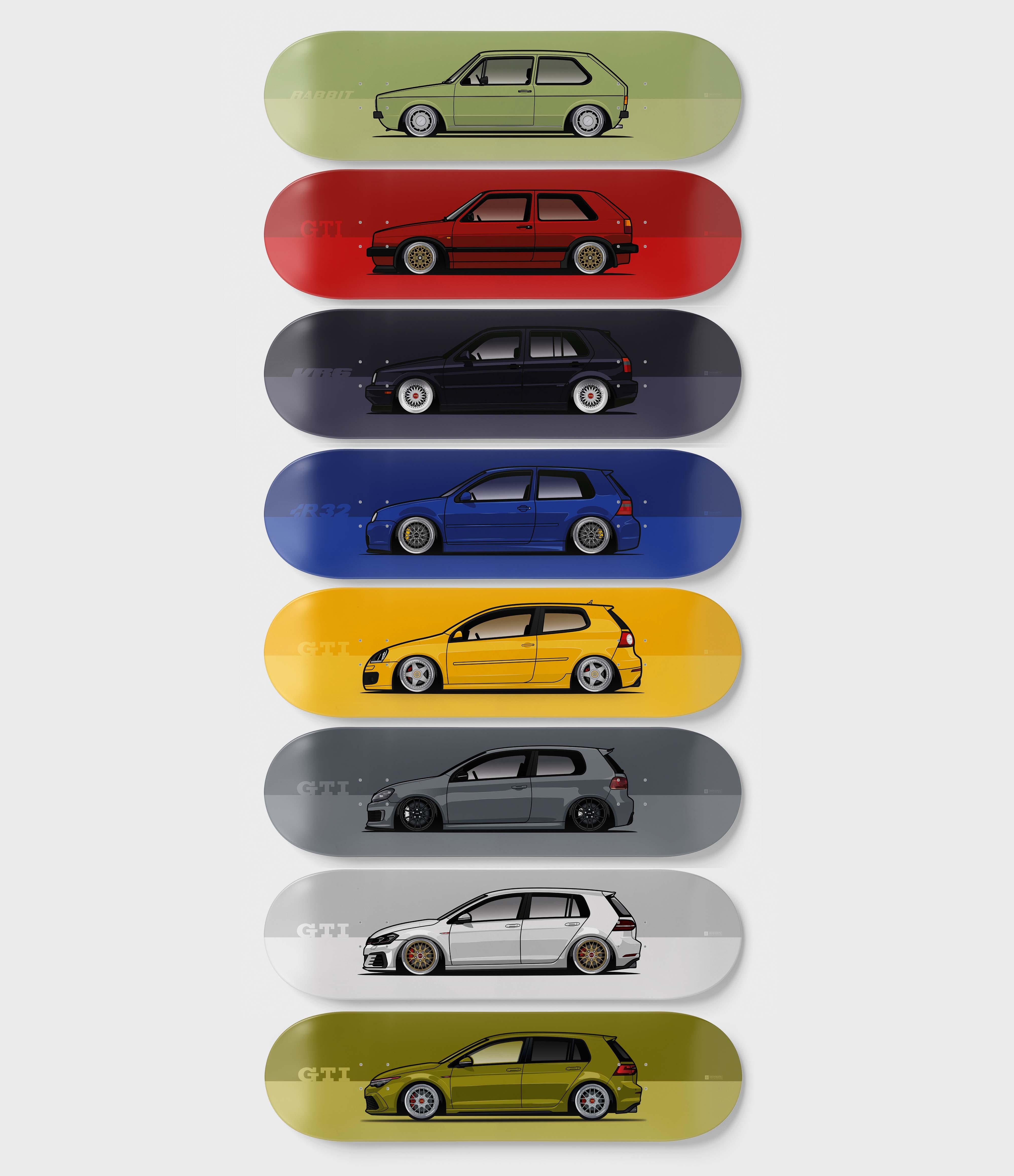
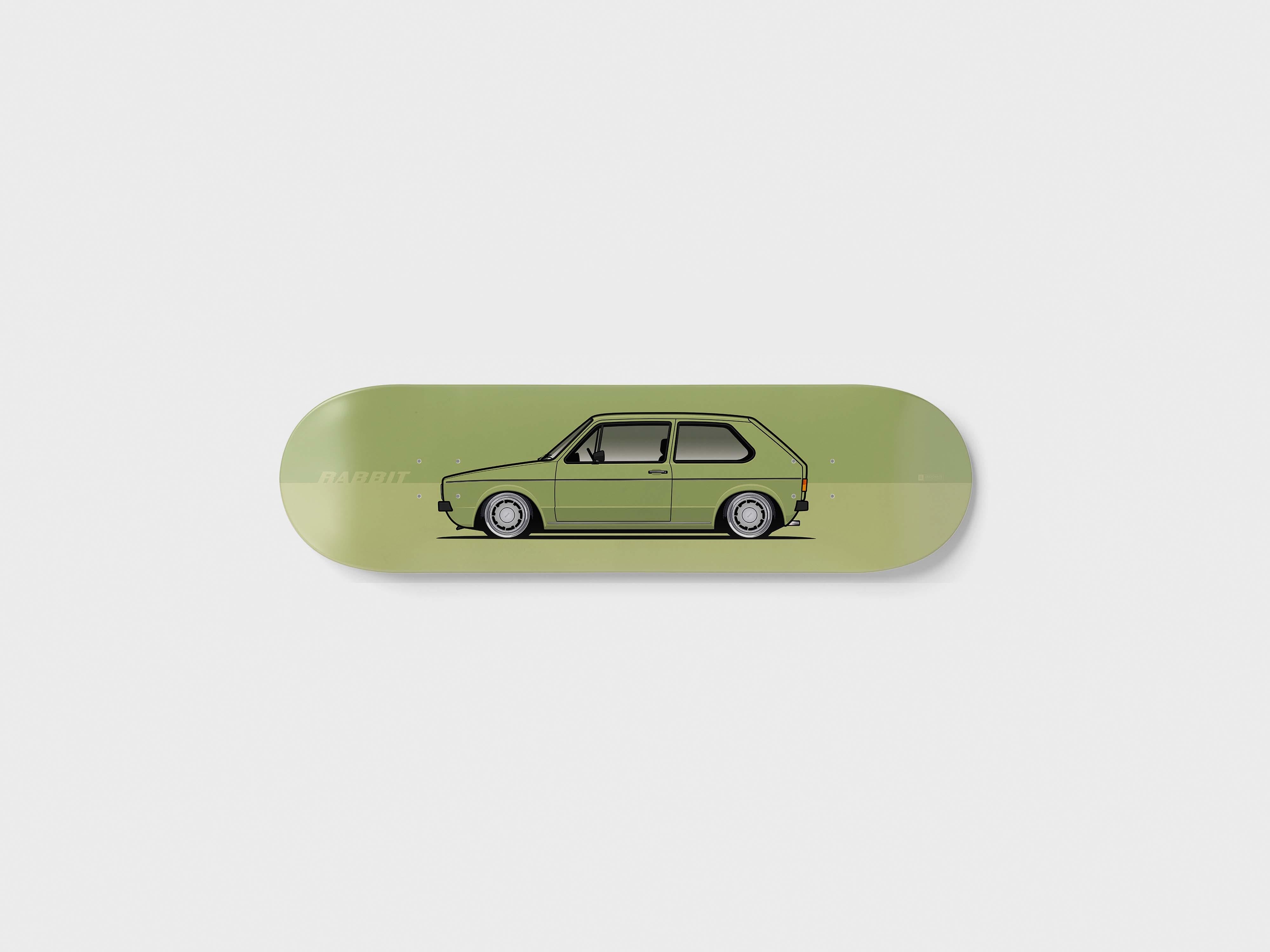
For American car enthusiasts of a certain generation, Rabbit is the name that comes first. The green Deckorate MK1 deck carries the Rabbit designation as a direct reference to that North American identity: the same car, a different name, an entirely different cultural resonance.
The secret project
The GTI was not an official Volkswagen project. In 1974, a small group of engineers and enthusiasts within Volkswagen — including Anton Konrad, then chief press officer, and engineers Alfons Löwenberg and Hermann Hablitzel — began developing a sporty version of the Golf without formal authorisation. There was no budget, no official schedule, and no guarantee it would ever reach production.
The project continued quietly until March 1975, when Hablitzel presented it to Toni Schmücker, the Chairman of the Board of Management, who approved it. The development order was formalised and given the designation EA195. An ambitious schedule was set. The team needed to have a production-ready car ready for the Frankfurt Motor Show in September 1975.
They made it. The Golf GTI was unveiled to the public and motoring press at the IAA in September 1975 to an enthusiastic response. But Volkswagen's engineers insisted it should meet the same quality and reliability standards as every other production VW before it went on sale. It did not go on sale until June 1976.
What the GTI was
The Golf GTI MK1 used a 1.6-litre fuel-injected four-cylinder engine producing 110 horsepower. In 1974, mechanical fuel injection on a small family car was unusual. The Bosch K-Jetronic system that Volkswagen used was derived from the injection technology on much more expensive cars and gave the GTI a throttle response and power delivery that carburettor-equipped competitors could not match.
The chassis was modified from the standard Golf with stiffer springs, lower ride height, anti-roll bars front and rear, and wider Pirelli P-slot alloy wheels. The result was a car that weighed around 810 kg and handled with a precision that contemporary road testers found remarkable. The top speed was 180 km/h. Zero to 100 km/h took around nine seconds, which was fast for a family hatchback in 1976.
The visual identity was equally deliberate. The red stripe across the front grille, the tartan sports seats, the golf ball-topped gear lever: each element was specific and immediately recognisable. When the original plan had been to build 5,000 units and call it a limited special, Volkswagen had not anticipated that customers would respond to this identity so completely. The GTI became a cultural object as much as a car.
Only in red or silver
At launch, the Golf GTI MK1 was available in exactly two colours: Mars Red and Diamond Silver. The choice was deliberate — the engineering team felt both colours suited the GTI's character and they wanted to keep the initial offering focused. Black was added shortly after launch. The red GTI became the definitive image: the red stripe across the grille, the black wheel arch mouldings, the Pirelli alloys.
That specific combination — Mars Red, black trim, chrome details, tartan interior — is what most people picture when they think of the original GTI. It is the image that appeared on posters, in brochures, and in the memories of an entire generation of car enthusiasts who grew up in the late 1970s and 1980s.
What it created
The Golf GTI MK1 created the hot hatch category. Before it, sports cars were sports cars and family cars were family cars. The GTI proved that the same car could be both: practical enough for daily use, fast enough to be genuinely rewarding on a good road, and affordable enough that ordinary people could own one.
Every car that followed in the category — the Ford Escort XR3, the Peugeot 205 GTI, the Renault 5 Turbo, the Honda Civic Type R, the Ford Fiesta ST, the Volkswagen Polo GTI itself — exists because the MK1 GTI proved the concept. The term hot hatch was applied retrospectively, years after the MK1 launched. Before the GTI, nobody needed the term because the category did not exist.
In 2004, Sports Car International ranked the Golf MK1 GTI as the third best car of the 1980s. In the fifty years since its launch, no reappraisal has seriously threatened that position.
The collector market today
Clean Golf MK1 GTIs have become increasingly valuable as the generation that grew up with them reaches the point of being able to pay what they are worth. Original, unmodified examples in early two-colour specifications command significant premiums. The cabriolet variant, produced until 1993, has its own devoted following. South Africa continued producing the MK1 until 2009 — the last market to do so — and those late South African cars represent the longest production run of any Golf generation by a significant margin.
The condition and specification that matter most to collectors: original paint, original interior (particularly the tartan seats), matching numbers engine, and ideally one of the early launch colours. A Mars Red 1976 GTI in original condition is a different proposition from a later, more common specification. The market has been pricing this correctly for the past decade.
On your wall
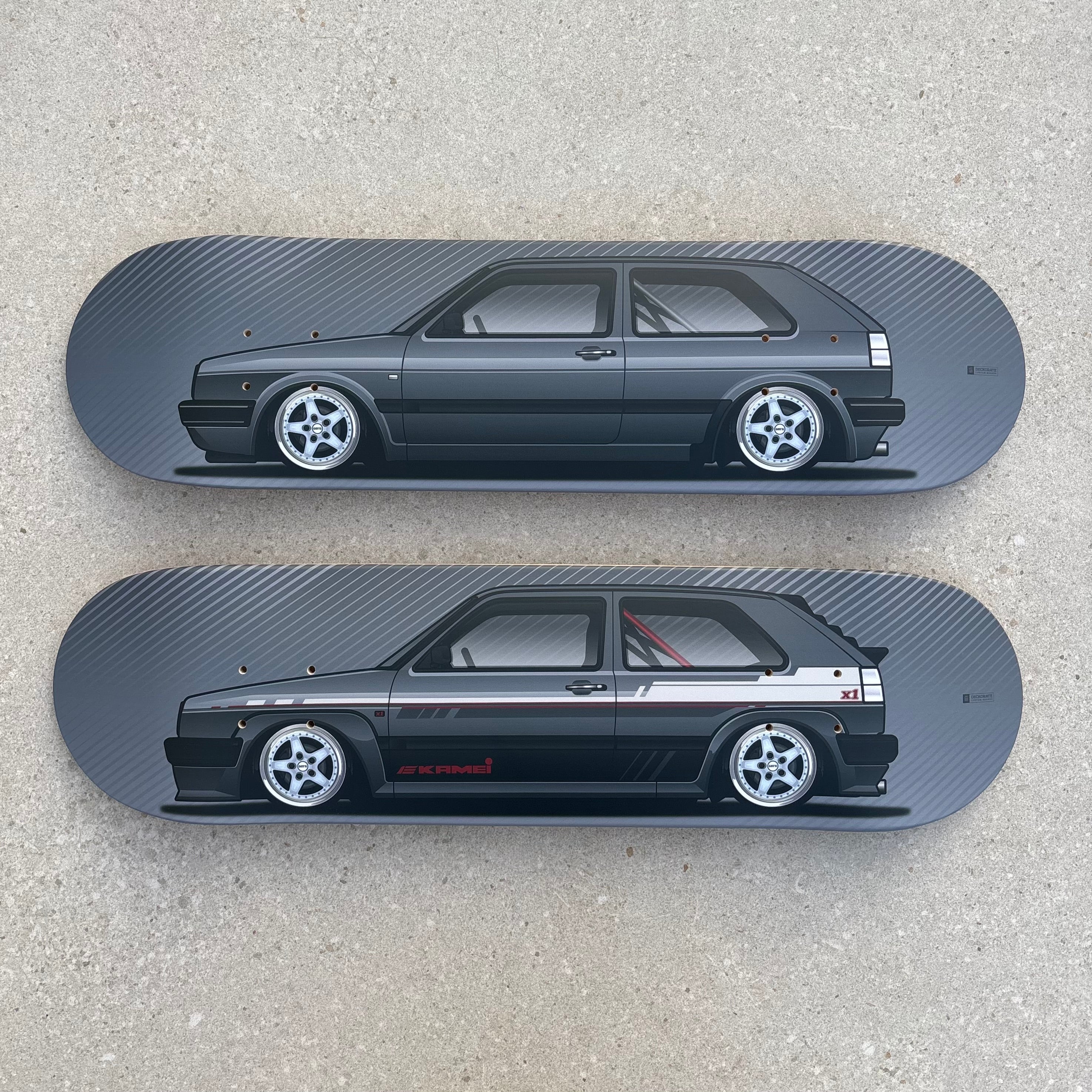
The Deckorate Golf MK1 collection covers two expressions of the original: the classic red GTI silhouette and the green Rabbit — the North American identity that an entire generation of American enthusiasts grew up knowing. Both decks share the same Giugiaro proportions that launched the hot hatch category and started one of the most significant model lines in automotive history.