BMW E30 M3: The Homologation Special That Won Seven Championships in One Season
In 1987 BMW entered a new car into touring car competition and won seven championships simultaneously. The World Touring Car Championship. The European Touring Car Championship. The DTM. The Italian, French, Australian and Japanese touring car titles. No car in the history of motorsport has won so many championships in its debut season. The car was the BMW E30 M3, and it was built for one reason: to race. Everything else came after.
The E30 M3 is one of eight cars covered in our guide to the greatest DTM cars of the 1990s. For the full story of the car that eventually replaced it as the dominant DTM force, read our Mercedes 190 E 2.5-16 Evolution II deep dive.
Why it existed
Group A touring car regulations required manufacturers to produce at least 5,000 road-going examples of any car they wanted to race. The regulation was designed to keep motorsport connected to production cars rather than allowing unlimited prototype development. In practice it created a category of vehicle that has no parallel in automotive history: the homologation special. A road car built not to be sold, but to justify a race car.
BMW had been competing in touring car racing with the M635CSi, which was reaching the limit of its development potential. The DTM was growing in prestige and budget, and Mercedes were preparing serious factory opposition. BMW Motorsport began work on an E30-based replacement in 1984. The car that resulted was presented at the Frankfurt IAA motor show in September 1985 and went on sale in 1986. It was called the M3.
The production requirement of 5,000 units was met. BMW sold 23,085 E30 M3s across all variants over the car's production run. Many of those buyers had no interest in racing. They were simply buying the most focused, most capable 3 Series ever built, and found that it was also an excellent road car. The racing justification and the genuine product quality happened to coincide.
The S14: designed in two weeks
The engine at the heart of the E30 M3 is one of the more remarkable engineering stories in the sport's history. Group A regulations required the racing engine to share its block, cylinder head, and basic architecture with the road car engine. BMW needed a four-cylinder unit displacing between 1,600 and 2,500cc to compete in the correct class against Mercedes.
Paul Rosche, BMW Motorsport's technical director, developed the S14 engine in approximately two weeks. He chose a four-cylinder over the available six-cylinder options because a shorter, stiffer crankshaft would allow higher engine speeds in racing tune. The solution was technically elegant: use the cylinder block from the 318i's M10 engine, bored and stroked to 2,302cc, combined with a cylinder head derived from the M88 six-cylinder unit used in the M1 supercar, shorn of two cylinders.
The result was an engine with four-cylinder dimensions and six-cylinder character. Dual overhead camshafts, four valves per cylinder, individual throttle bodies, and a rev ceiling that in racing trim reached 8,200 rpm producing 300 horsepower. The road car version produced 195 horsepower in European specification, which in 1986 made it one of the most powerful naturally aspirated four-cylinder production engines in existence.
1987: seven championships in one season
The E30 M3's debut season in 1987 remains without precedent in touring car history. The car won simultaneously in Germany, across Europe, around the world, and in every major national series it entered. Roberto Ravaglia won the World Touring Car Championship. Winfried Vogt won the European Touring Car Championship. Eric van de Poele won the DTM. National titles followed in France, Italy, Australia and Japan.
The dominance was not simply a matter of having the best car. The M3 was genuinely superior in almost every measurable dimension: lighter than the opposition, with better aerodynamics, a more willing engine at high revs, and a chassis balance that allowed drivers to exploit it consistently across different circuit types and conditions. Teams running customer versions of the car, without full factory support, were competitive immediately. The car did not require a specific set-up to go fast. It went fast in almost anyone's hands.
The evolution programme
Group A regulations permitted manufacturers to homologate updated variants of their car annually, provided at least 500 road-going examples of the updated version were produced. BMW used this provision to develop the M3 continuously across its racing career.
The Evolution I arrived in 1987 with revised engine management and aerodynamic improvements. The Evolution II followed in 1988 with a higher-revving version of the S14, producing around 220 horsepower in road trim. The Sport Evolution, known as the Evo 3, came in 1990 as the final and most extreme road version: the S14 engine bored out to 2,467cc producing 238 horsepower, with adjustable front and rear spoilers, wider front fenders, and red spark plug wires that became the visual signature of the final specification. Only 600 Sport Evolution road cars were built. In racing trim the 2.5-litre engine produced around 340 horsepower at a 9,300 rpm redline.
The evolution programme kept the M3 competitive from 1987 through to 1990, when the arrival of the Mercedes 190 E 2.5-16 Evolution II and the Audi V8 Quattro under the new regulations finally ended BMW's DTM dominance. By that point the M3 had won everything available to win.
The road car legacy
The E30 M3 was never supposed to be a significant road car. It was a homologation exercise that happened to be excellent to drive. The combination of the high-revving S14 engine, the wide-body stance over the standard 3 Series, the limited-slip differential and the communicative chassis created a package that driving journalists of the era described as the most rewarding front-engine, rear-drive car available at any price.
Production ended in 1991. Values fell through the 1990s as newer M cars arrived and the E30 M3 began to look dated. Then the collector market found it. Cars that were available for under £10,000 in the early 2000s now sell for £60,000 to £150,000 depending on specification, colour and history. DTM-specification race cars command seven figures at major auctions. The Sport Evolution, produced in the smallest numbers, consistently achieves the highest prices among road variants.
Every BMW M3 that has followed owes its existence and its market position to the E30. The M3 nameplate carries the weight it does because the first car to wear it was exceptional, and won championships that justified the badge before a single road car customer had taken delivery.
On your wall
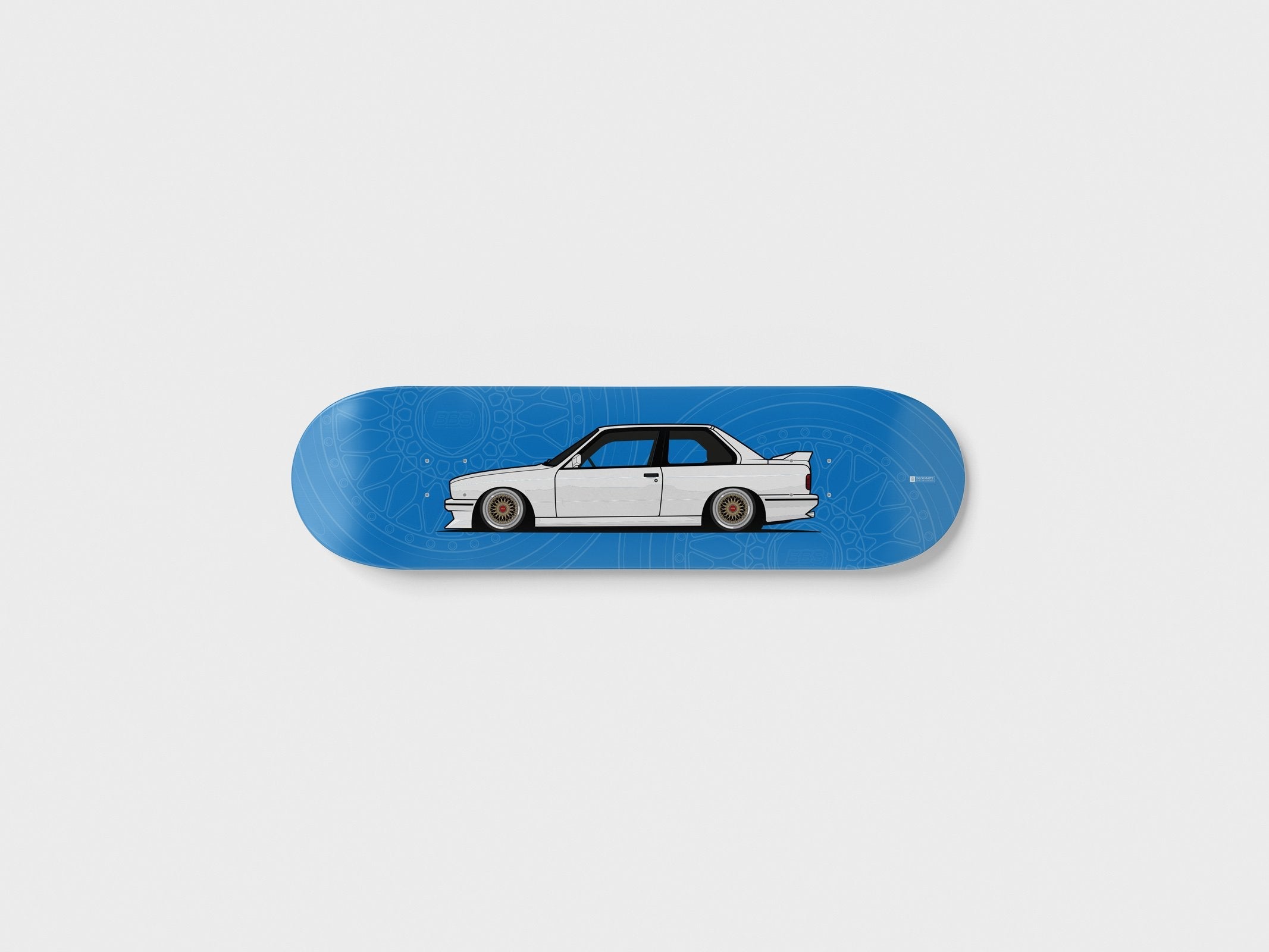
The Deckorate E30 M3 collection covers the car across three expressions: the DTM Warsteiner livery that defined the racing era, the LTO collaboration that brought the E30 M3 into contemporary car culture, and the DTM Retro Racer 3-pack that places the E30 M3 alongside the Alfa Romeo 155 V6 Ti and Audi V8 Quattro from the golden era of German touring car racing.

Shop the BMW E30 M3 DTM deck →

Shop the BMW E30 M3 LTO deck →