VW Golf MK2 GTI: The Definitive Hot Hatch and the Kamei Era
The Golf MK1 created the hot hatch. The MK2 defined it. Launched at the Frankfurt Motor Show in September 1983, the second generation Golf GTI took everything the original had established and made it better: more refined, more powerful, more complete. In 1988 it was the best-selling Golf in the United Kingdom, moving over 11,000 GTI units in a single year. It became the benchmark that every rival spent the decade trying to match. And then the tuning culture found it, and it became something else entirely.
This is part of our complete VW Golf guide covering every generation from MK1 to MK8. For the story of where it all began, read our VW Golf MK1 GTI guide.
The Frankfurt launch
Volkswagen unveiled the MK2 at the Frankfurt IAA in September 1983 alongside the second-generation Jetta. The new car was designed in-house by VW's design director Herbert Schäfer, clearly influenced by the Giugiaro language of the MK1 but more rounded and aerodynamic: a drag coefficient of 0.34 compared to 0.40 for the original. It was 170mm longer, 56mm wider, and appreciably roomier inside. A five-door version was available from the start for the first time.
The GTI launched with essentially the same 1.8-litre eight-valve engine as the late MK1, producing 112 horsepower. The chassis was revised with longer-travel suspension and improved brakes. Power steering was offered for the first time on a Golf. The result was a car that was more comfortable, more capable, and more grown-up than its predecessor without losing the directness that had made the MK1 GTI worth caring about.
The 16V: when it got serious
The moment that transformed the MK2 GTI's reputation arrived in August 1986: the 16-valve engine. The 1.8-litre 16V unit produced 139 horsepower, making it faster, more willing to rev, and more aggressive in character than the eight-valve car. It was also lower and stiffer, with a tuned suspension setup that sharpened the handling further.
The 16V was distinguishable by its bee-sting aerial, its 16V badging, and its slightly more assertive stance. On a fast road it was genuinely exciting in a way that the eight-valve, for all its competence, was not quite. The combination of a lightweight chassis around 1,000 kg, 139 horsepower, precise manual steering, and a chassis that communicated everything through the controls placed it among the best driver's cars available at any price in the late 1980s.
By 1988 the GTI in both eight and sixteen-valve forms was the best-selling Golf variant in the United Kingdom. The hot hatch category that the MK1 had created now had a car that the mainstream market genuinely wanted.
The special editions: G60, Rallye and the Golf Limited
Volkswagen used the MK2 platform to produce some of the most interesting variants in Golf history. The G60 used a supercharged version of the 1.8-litre engine producing 160 horsepower, named after the G-Lader supercharger with a 60mm scroll diameter. Quieter and more tractable than a turbocharged alternative, it gave the MK2 a performance level that nothing in the GTI range could match.
The Rallye Golf was a homologation special built to qualify for Group A rally competition. Wide box wheel arches, the G60 supercharged engine, syncro four-wheel drive, and a price tag in the UK that matched a well-specified BMW 5 Series. Only 5,000 were built for homologation. Fewer than that survive today.
The Golf Limited was the rarest MK2 of all: just 71 cars built by Volkswagen Motorsport, each combining the 16-valve engine with the G60 supercharger in a single unit producing around 210 horsepower. They were built entirely by hand, sold through VW dealers at enormous cost, and represent the most extreme road car the MK2 platform ever produced. A clean Golf Limited is among the most valuable MK2 Golfs in existence.
Kamei and the tuning culture
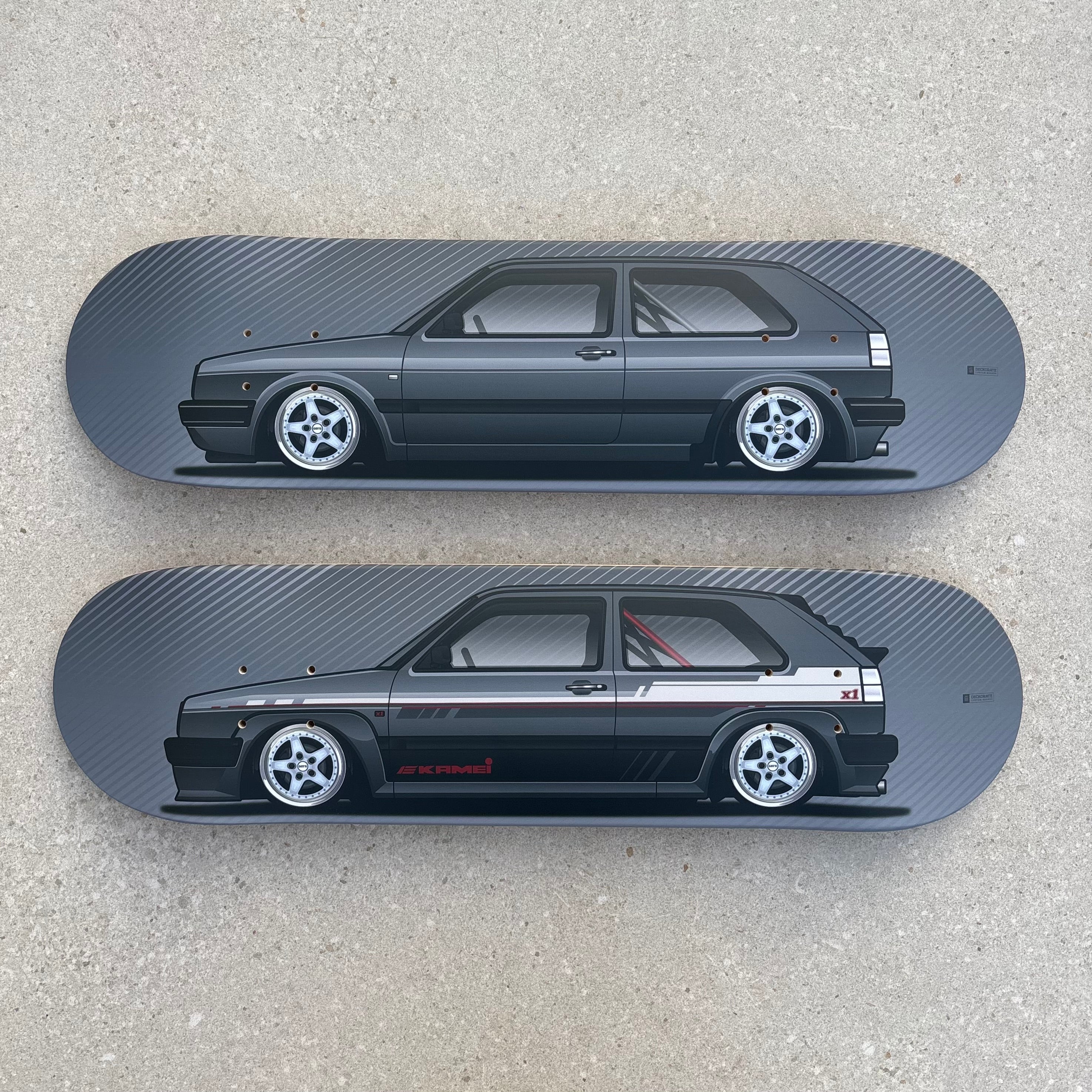
The MK2's clean, upright body made it the ideal canvas for period tuning accessories. The most significant supplier was Kamei, a German company that had been producing aerodynamic bodywork for Volkswagen models since the late 1970s. Kamei's front spoiler kit for the MK2 became one of the defining visual modifications of the era: a deep front air dam that lowered the car's visual centre of gravity and gave it an aggressive stance that the standard bumper did not offer.
Kamei worked closely with Volkswagen and conducted wind tunnel testing at the Wolfsburg facility. Their kits were not aftermarket additions in the negative sense: they were engineered accessories that reduced front axle lift and improved aerodynamic efficiency. VW offered Kamei and Centra accessories through the dealer network in the 1980s, meaning a factory-fresh MK2 could leave the showroom with a Kamei front spoiler fitted as a dealer option.
The complete period-correct MK2 build is now a well-defined aesthetic: Kamei front spoiler, BBS RM or RS alloy wheels, H&R or Bilstein suspension lowering springs, colour-coded bumpers, and either the eight or sixteen-valve GTI engine. This combination defined European car culture in the mid-1980s and has never entirely gone out of fashion. The market for clean, correctly-modified MK2 GTIs has grown consistently for the past fifteen years.
The collector market today
The MK2 GTI occupied the sweet spot of European hot hatch culture for most of a decade. It was aspirational but attainable, fast but usable, and available in sufficient numbers that it was genuinely present on the roads rather than a rare sight. That ubiquity meant that many were modified, many were damaged in the joyriding epidemic of the late 1980s and early 1990s, and many were simply used until they were no longer worth maintaining.
The survivors have appreciated significantly. Clean, low-mileage 16V examples with correct specification command prices that would have seemed absurd fifteen years ago. The eight-valve car, once dismissed as the slower option, is valued in its own right as the purer, more analogue version of the MK2 GTI experience. Correctly-modified cars with period-correct Kamei and BBS parts can command premiums over standard specification, provided the work is done properly.
The generation that grew up with MK2 GTIs as accessible used cars in the 1990s now has both the nostalgia and the means to acquire the best examples. Prices reflect this, and the trajectory shows no sign of reversing.
On your wall
The Deckorate Golf MK2 GTI deck captures the generation in its most recognised specification: the clean side profile, the period BBS alloys, the GTI stance that defined the hot hatch era. The car that Kamei built kits for, that teenagers pinned to bedroom walls in the 1980s, and that the collector market has been reappraising upward ever since.

Shop the VW Golf MK2 GTI deck →