Mazda 787B: The Rotary Engine That Won Le Mans
On the morning of 23 June 1991, a sound unlike anything in endurance racing history carried across the Circuit de la Sarthe. Not the rumble of a V8 or the howl of a V12 but a high-pitched mechanical shriek that climbed to 9,000 rpm and beyond. The Mazda 787B was running at Le Mans. By the following morning, the Japanese manufacturer that nobody had picked to win had become the first Japanese team in history to take the overall victory, driving a car powered by technology every other manufacturer had abandoned decades earlier.
The 787B is part of the Deckorate JDM collection alongside the Nissan Skyline R34 GT-R, the Toyota Supra MK4 and the Hakosuka. For the full JDM story, read our JDM wall art guide.
The rotary engine and why nobody else believed in it
The Wankel rotary engine was invented by German engineer Felix Wankel and first produced commercially in the early 1960s. Its operating principle is fundamentally different from a conventional piston engine: instead of pistons moving up and down inside cylinders, triangular rotors spin within an oval-shaped housing, creating combustion chambers that expand and contract as the rotor turns. The design produces three power strokes per revolution rather than the one produced by a four-stroke piston engine of equivalent size.
The theoretical advantages are significant. Fewer moving parts means less mechanical complexity and less vibration. The compact design allows for a lower centre of gravity. The ability to rev freely beyond 9,000 rpm without the inertia of reciprocating masses produces a power delivery that feels entirely different from any piston engine.
The practical disadvantages were equally significant. Rotary engines consume fuel at a rate that piston engines of equivalent power do not. They have historically struggled with reliability under sustained high-load operation. The apex seals that maintain combustion chamber integrity are a known weakness. Every major manufacturer that evaluated the Wankel engine in the 1960s and 1970s concluded that the disadvantages outweighed the advantages and moved on.
Mazda did not move on. They were the only manufacturer in the world to persevere with rotary technology into production cars and into racing, spending decades developing solutions to the problems that had defeated everyone else.
The road to 1991
Mazda's Le Mans programme began in 1970 and continued for nine consecutive years before the 787B's victory. The early years established the team's presence and accumulated data. The 757, 767 and 787 prototypes through the mid to late 1980s showed the rotary engine's potential in endurance racing while exposing its remaining weaknesses.
The 787 debuted in 1990 with the R26B engine but suffered reliability problems that ended its challenge early. Mazda's engineers spent the winter analysing every failure and developing solutions. The 787B that appeared at Le Mans in 1991 was the result of that process: the same fundamental architecture, significantly improved in every area where the 787 had fallen short.
The R26B engine in the 787B used four rotors, three spark plugs per rotor, ceramic apex seals to address the reliability weakness that had plagued earlier designs, and a continuously variable intake system that produced torque across a wider rev range than any previous rotary race engine. Power output was around 700 horsepower in race trim, with qualifying configurations approaching 900. The 787B's complete weight was 830 kg. The power-to-weight ratio was extraordinary.
There was urgency to the programme beyond the normal desire to win. The FIA had announced that 1991 would be the final season in which rotary engines were permitted under Group C regulations. New rules for 1992 required naturally aspirated 3.5-litre piston engines. Whatever Mazda was going to achieve with the rotary at Le Mans, 1991 was their last chance.
The 1991 race
Mazda entered four 787Bs. The number 55 car, driven by Johnny Herbert, Volker Weidler and Bertrand Gachot, started from eighth on the grid. The favourites were the Sauber-Mercedes C291 and the Jaguar XJR-12. Mazda was not seriously discussed as a potential winner at the start of the race.
The race unfolded over 24 hours in the way that Le Mans often does: through the attrition of the faster cars. The Sauber-Mercedes suffered electrical problems. The Jaguar entries encountered mechanical failures. Mazda's preparation for reliability, driven by the lessons of 1990, meant the number 55 car kept running when its rivals did not.
At 3pm on Sunday 23 June, the number 55 787B crossed the line to win the 59th running of the 24 Hours of Le Mans. Mazda had covered 4,003 km over 362 laps. They won by two laps from the second-placed Sauber-Mercedes. It was the first overall victory for a Japanese manufacturer at Le Mans. It was the first and only victory for a rotary-powered car at Le Mans. It remains both of those things today.
The sound
People who were at Le Mans in 1991 remember the 787B primarily through sound. The four-rotor R26B at full throttle on the Mulsanne Straight produced a noise that contemporary witnesses described as a scream, a shriek, a sound that carried across the circuit and could be heard well before the car was visible. There were reportedly marshals stationed along certain sections of the circuit to warn spectators when the 787Bs were approaching so they could cover their ears.
The sound is unique because of what produces it. A four-rotor Wankel engine producing three power strokes per revolution at 9,000 rpm generates a frequency and intensity that has no equivalent in endurance racing. It is louder and higher-pitched than any comparable piston engine. Recordings from 1991 convey some of it. Witnesses consistently report that recordings do not fully convey all of it.
The FIA's decision to ban rotary engines from Group C after 1991 means the sound will never be heard at Le Mans in competition again. The 787Bs that Mazda keeps running for demonstration purposes at historic events represent the only remaining opportunity to hear it at full throttle on a racing circuit.
The rotary ban myth
A persistent story holds that the FIA banned rotary engines specifically because Mazda won, that European manufacturers pressured the governing body to eliminate the technology that had defeated them. The story is compelling and wrong.
The rule changes that eliminated rotary engines from Group C were announced before the 1991 race took place, as part of a broader FIA strategy to reduce development costs and align Le Mans regulations with Formula 1's 3.5-litre naturally aspirated rules. The timing was coincidental. Mazda won under regulations that were already scheduled for replacement regardless of the result. The ban on rotary engines was not a reaction to Mazda's victory. It was the context in which Mazda's victory became their only opportunity.
The legacy
The 787B's victory stands as one of the most significant results in the history of Le Mans for several reasons simultaneously. It was the first Japanese win. It was the only rotary win. It demonstrated that a technology dismissed by every major manufacturer could, in the right hands and with enough persistence, defeat the most sophisticated racing machinery in the world.
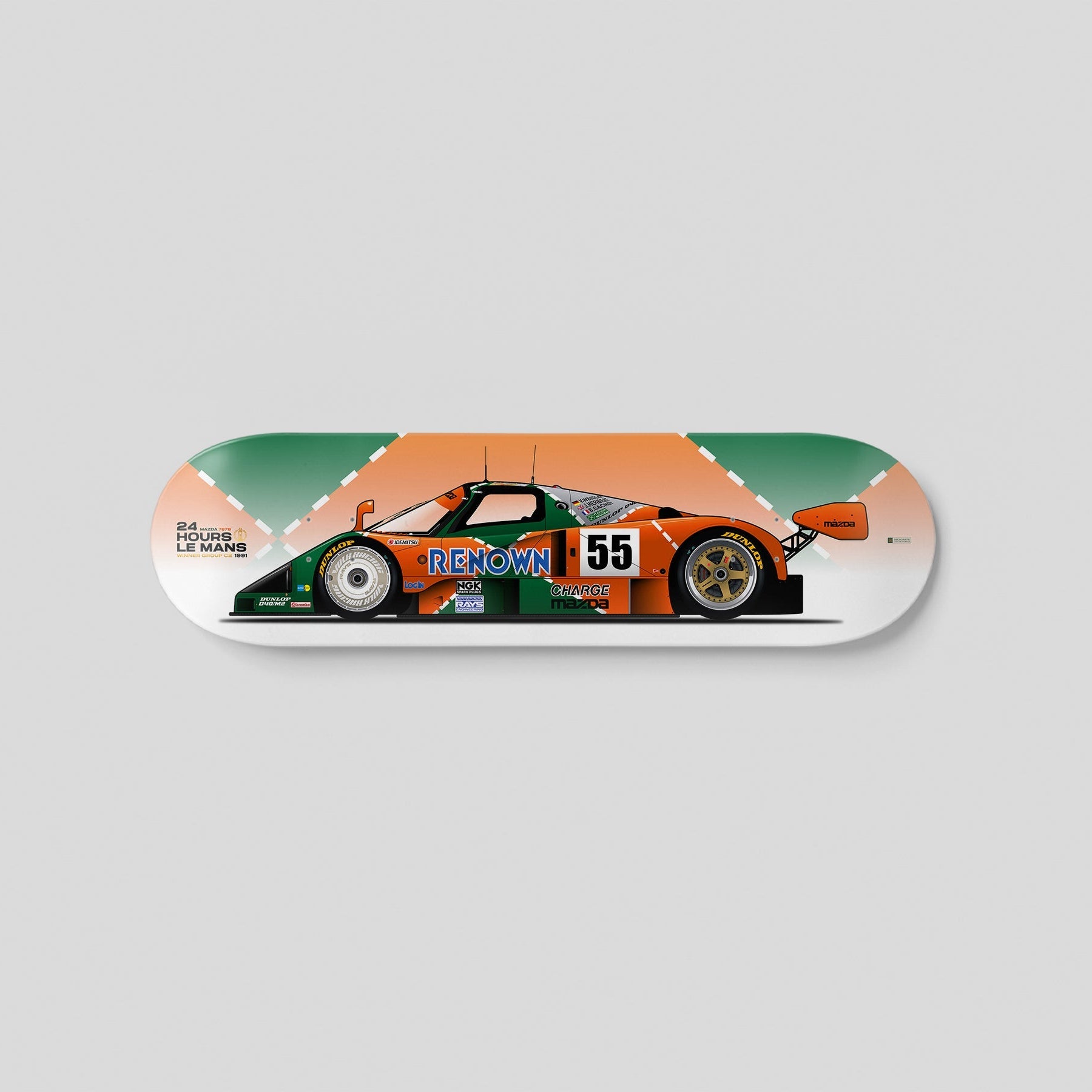
For Mazda, the victory is the centrepiece of their motorsport identity. The orange and green Renown livery of the number 55 car is the most recognisable image in the brand's history. Mazda has brought the surviving 787Bs back to Le Mans multiple times for demonstration laps, and the circuit announcements of their approach remain among the most anticipated moments of those events.
The car validated a philosophy that Mazda had maintained when every commercially rational argument pointed elsewhere: that the rotary engine was worth pursuing, that its advantages could outweigh its disadvantages with sufficient development, and that winning at Le Mans was possible for a manufacturer that most of the paddock had never taken seriously as a threat.
On your wall
The Deckorate Mazda 787B deck captures the number 55 car in the orange and green Renown livery that crossed the line at Le Mans in 1991. The first Japanese Le Mans winner. The only rotary Le Mans winner. A car whose significance in motorsport history is entirely disproportionate to the one season it competed.