In March 1990 at the Geneva Motor Show, Mercedes-Benz unveiled a road car with a rear wing so large and so aggressive that it reportedly sent BMW's head of research and development straight back to the wind tunnel. The 190 E 2.5-16 Evolution II was not supposed to be subtle. It was supposed to win. And in 1992, it did, taking 16 of 24 races in the Deutsche Tourenwagen Meisterschaft and changing what Mercedes-Benz meant as a performance brand.
The Evolution II is one of eight cars covered in our guide to the greatest DTM cars of the 1990s. This is its full story.
The battlefield: DTM in the late 1980s
To understand what the Evo II was built for, you need to understand the DTM it entered. The Deutsche Tourenwagen Meisterschaft of the late 1980s was the most competitive touring car series in Europe, with factory-backed teams from BMW, Mercedes, Audi, Ford and Opel fighting over a championship that generated enormous public and media attention in Germany.
BMW had the E30 M3, a car purpose-built for racing supremacy that had dominated the series since 1987. Mercedes had the 190 E 2.3-16, a Cosworth-engined compact that had shown promise but could not consistently match the BMW. In 1988 Mercedes upgraded to a 2.5-litre engine. In 1989 they launched the Evolution I, a homologation special built to introduce improved aerodynamics and suspension to the racing regulations. They won eight of 22 races that season. The championship still went to BMW.
It was not enough. Mercedes went back to work.
Building the Evolution II
The Evolution II was unveiled at Geneva in March 1990, and its most striking feature was immediately obvious: a towering adjustable rear wing that sat on swan-neck uprights above the boot lid, generating downforce that no production-based touring car had previously attempted. The front splitter was enlarged. The wheel arches were widened to accommodate wider track and larger tyres. Every aerodynamic element had been developed directly from the racing car's wind tunnel programme.
The story about BMW's Wolfgang Reitzle has become one of DTM's most repeated anecdotes. On seeing the Evo II's rear wing at Geneva, Reitzle reportedly commented that the laws of aerodynamics must operate differently between Stuttgart and Munich. Whether or not the quote is accurate, BMW's subsequent aerodynamic development work accelerated noticeably after the Evo II's debut.
Mercedes produced exactly 502 road cars to meet the DTM homologation requirement of 500 units. Every car left the factory in the same colour: blue-black metallic. Each was individually numbered. Examples marked 222/500 or 347/500, with their place in the limited production run part of the car's identity. The road car produced 235 horsepower from its 2.5-litre four-cylinder engine, with an optional AMG PowerPack available for an additional DM 18,000 that pushed output to around 265 horsepower.
The racing car was a different proposition entirely. In full DTM specification the engine produced 373 horsepower at a 7,800 rpm redline. The car's development had been handled in close collaboration with AMG, the performance division that Mercedes would formally acquire in 1999 but which had been partnering with the factory on motorsport projects for years.
1992: total domination
The Evo II competed in the DTM from 1990, winning its first race at the Diepholz airfield circuit in August of that year. But 1992 was the season that defined it.
Mercedes entered four Evo IIs for the 1992 championship, driven by Klaus Ludwig, Bernd Schneider, Jochen Mass and Ellen Lohr. Ludwig, who had been recruited from Ford, won the drivers' championship in the car numbered 3. The team won 16 of the 24 championship rounds. No other car came close.
Bernd Schneider drove one of the four factory Evo IIs to four race victories that season. Schneider would go on to become the most decorated driver in DTM history, winning five championships across his career, but 1992 in the Evo II was where the legend began.
The margin of dominance was unprecedented. Sixteen wins from 24 races is a 67% win rate in a series with multiple manufacturers and multiple factory-backed teams. The combination of the AMG-developed engine, the aerodynamic package that the competition had spent two years trying to match, and the quality of drivers Mercedes had assembled produced a season that remains one of the most complete performances in touring car history.
The car that built AMG
The Evo II's significance extends beyond the racing results. Before 1992, AMG was a respected tuning and engineering partner. After 1992, it was the performance division that had just won the DTM. The association between the Evo II's success and AMG's name transformed how the brand was perceived, both internally at Mercedes and in the wider automotive market.
The road car had already established the template for what AMG would become: a Mercedes with more power, more aggressive aerodynamics, and a clear intention to go beyond what the standard car offered. The Evo II simply proved that the performance was real rather than cosmetic. It had won at the highest level of touring car racing in Europe. The cars that followed (the C36 AMG, the C43, the eventual C63 and the current GT range) trace their commercial and cultural legitimacy back to what the Evo II achieved.
The road car as collector's piece
The 502 road cars built for homologation have become among the most sought-after collector Mercedeses of the modern era. Their original blue-black metallic paint, their individual production numbers, and their direct connection to one of the most dominant seasons in DTM history have made clean examples increasingly rare and valuable.
The adjustable rear wing is the defining visual element. On a compact saloon from 1990, it looks completely out of place in the best possible way. The car's proportions are otherwise modest. This is a 190, a car originally built to appeal to younger buyers who couldn't yet afford a full-size Mercedes, but the wing announces its intentions to anyone who sees it. It is the most honest expression of what homologation specials were: road cars built to justify race cars, wearing the race car's most extreme components.
The Evo II on your wall
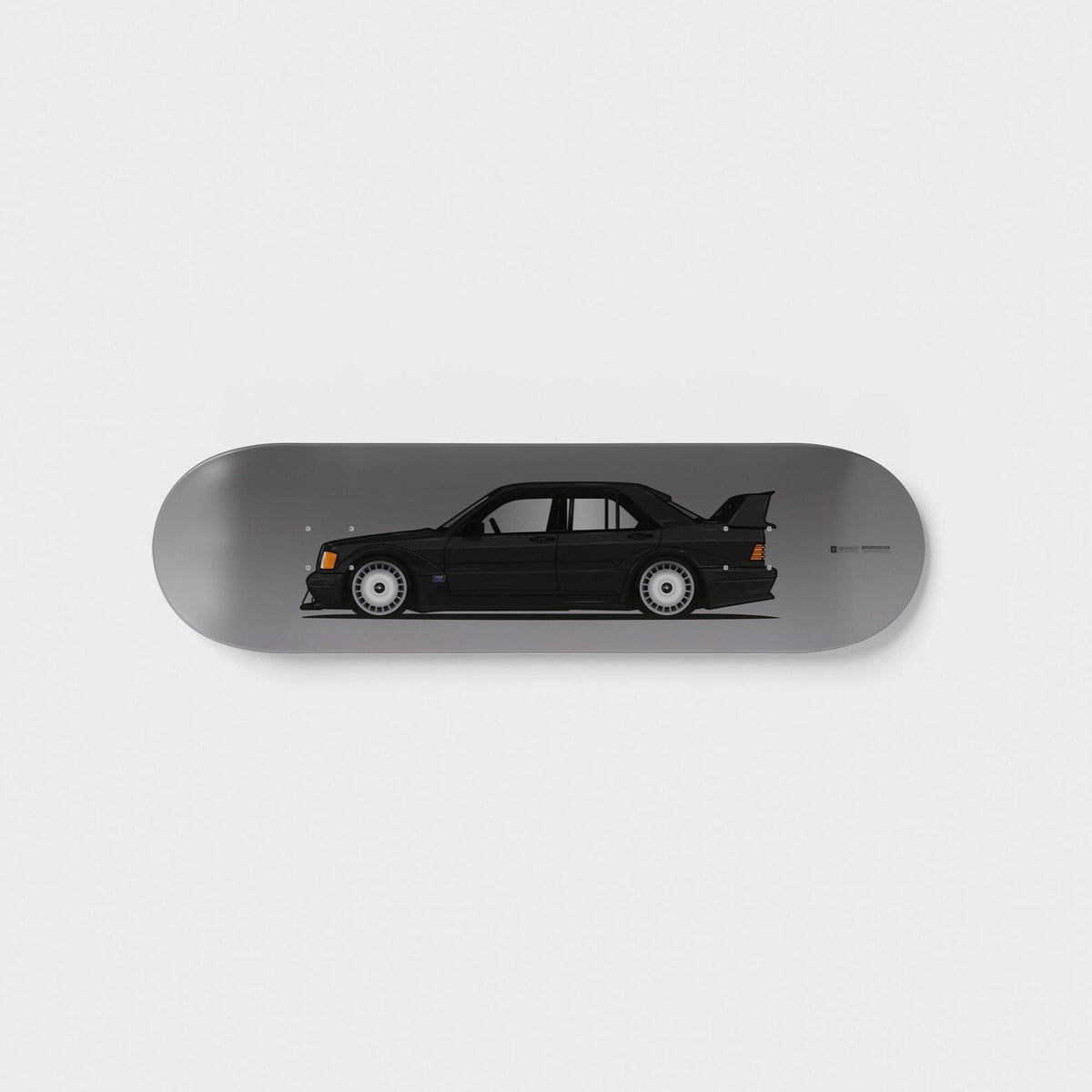
The Deckorate Mercedes 190 E 2.5-16 Evolution II deck captures the DTM race car in the livery that defined the 1992 season. The D2-sponsored silver finish, the period-correct aerodynamic package, the stance and wheel fitment of the championship-winning car. For anyone who follows the DTM's golden era or considers the Evo II the moment Mercedes became a genuine performance brand, this is the deck.

Shop the Mercedes 190 Evo II deck →