Senna vs Schumacher: The Greatest Rivalry F1 Never Got to Finish
Two drivers, two philosophies
Senna and Schumacher represented fundamentally different approaches to racing, formed by fundamentally different eras.
Senna came from a world where drivers settled things in person. After an incident, you found the other driver in the paddock and you had it out. He had famously confronted Alain Prost, Nelson Piquet and others over the years, sometimes physically. He believed that a racing driver carried a personal responsibility for his actions on track, and that this responsibility extended to accounting for those actions face to face. He was three times World Champion by the time Schumacher arrived as a serious force. He was the old guard defending territory.
Schumacher came from a newer generation that processed racing differently. Clinical, strategic, relentlessly focused on performance rather than honour. When Senna approached him after an incident at the 1992 German Grand Prix at Hockenheim, Schumacher famously told him to get lost. The response was not defiance. It was indifference. He simply did not operate within the same framework of paddock protocol that Senna considered fundamental.
That gap in philosophy was the source of almost every incident between them.
1992: the rivalry begins
The 1992 season belonged to Nigel Mansell and the Williams-Renault FW14B, which was so dominant it might as well have been racing in a different championship. But behind Mansell, a secondary battle was developing that would matter more in the long run.
Schumacher, in his second full season with Benetton, was consistently outperforming his machinery and closing the gap to Senna, who was in an increasingly uncompetitive McLaren. At the Brazilian Grand Prix, Senna was fighting a car with a hydraulics problem and still managed to hold off Schumacher for third place. Schumacher, convinced Senna had blocked him deliberately, was furious. Senna's view was that he had simply raced. The post-race confrontation established the template for what would follow.
The Belgian Grand Prix at Spa produced one of the most significant moments of the early rivalry. Schumacher won. Senna finished second. They stood together on the podium for the first time, the old champion and the new threat, and anyone watching could see that the sport's centre of gravity was shifting.

The Hockenheim incident that year produced Schumacher's dismissal of Senna's confrontation attempt. The story of that exchange was retold by F1 journalist Roger Benoit decades later: Senna sought out Schumacher to discuss the incident, and Schumacher sent him away. Senna, according to those present, was visibly taken aback. He had never been dismissed before.
1993: escalation
Prost joined Williams for 1993 and won the championship comfortably, which meant the real battle for Senna was still the secondary one: holding position against Schumacher while the Williams pair pulled away.
At the South African Grand Prix in Kyalami, Schumacher and Senna collided at the start. Senna retired. At the same circuit later in the season, after Schumacher had passed Senna on track, Senna closed the door on him during the second attempt and Schumacher spun out. Schumacher retired. Both drivers blamed each other publicly.
The pattern was clear: these were two drivers who both believed they had the right to the same piece of track, and neither was prepared to yield. In most situations that is resolved by one driver being faster. Between Senna and Schumacher in 1993, on roughly equivalent machinery for much of the year, neither was definitively faster than the other. The collisions were the natural consequence.
Prost retired at the end of 1993. Senna signed for Williams. Schumacher was staying at Benetton. The stage was set for a genuine championship fight between the two of them in 1994.
1994: three races and Imola
The 1994 season began with Schumacher winning the first two races of the year in Brazil and the Pacific Grand Prix at Aida, with Senna retiring from both. The Williams was faster but unreliable. The Benetton was slightly slower but Schumacher was driving it beyond its limits.
Three races in, the championship stood at Schumacher 20 points, Senna 0. Senna had not finished a race. The rivalry that everyone had anticipated was unfolding badly for him and he knew it.
At the San Marino Grand Prix at Imola on 1 May 1994, Senna crashed at Tamburello corner on lap 7 while leading. He died from his injuries. He was 34 years old. He had driven 162 races and won 41 of them. He had three World Championships. He had never been beaten cleanly by Schumacher in a direct battle.
Schumacher won the championship that year. He was 25 years old. He would go on to win six more.
The question that was never answered
The debate about who was the greater driver has never been resolved, and it never can be. Senna died before the rivalry could produce a definitive outcome. What exists instead is evidence, interpretation, and argument.
The case for Senna: his qualifying performances remain the most extraordinary in the history of the sport relative to his machinery. His wet-weather driving was in a category of its own. He achieved his three championships in cars that were not always the fastest on the grid. His 1993 season in the uncompetitive McLaren, during which he won five races against Prost's Williams-Renault, is regarded by many engineers and analysts as the best season any driver has ever produced relative to their machinery.
The case for Schumacher: seven World Championships, 91 wins, records that stood until Hamilton broke them twenty years later. The 2000-2004 Ferrari dynasty was the most sustained period of dominance by a single driver in the sport's history. His technical feedback to engineers transformed how teams developed cars. His physical conditioning set a new standard for F1 drivers that the entire sport adopted.
The honest answer is that they were different kinds of great. Senna was the purest driver: the one whose talent expressed itself most completely in qualifying, in the rain, in moments of individual brilliance. Schumacher was the most complete racing package: the one whose talent extended to team management, physical preparation, technical development, and the relentless accumulation of points over a full season.
Which matters more depends on what you think Formula 1 is for.
The legacy
Both drivers changed Formula 1 in ways that outlasted their careers.
Senna's death accelerated a fundamental transformation of safety in the sport. The FIA's response to Imola produced changes to circuits, car design and medical infrastructure that have saved numerous lives since. Every driver who has walked away from an accident that would have killed a 1994-era driver owes something to the changes that followed Senna's death.
Schumacher's era at Ferrari produced the template for modern F1 team operations: the integrated approach to driver development, engineering collaboration and mental preparation that every top team now follows. His relationship with Ross Brawn and Jean Todt redefined what a driver-team partnership could achieve.
Both men became symbols that extend beyond the sport. Senna in Brazil occupies a space somewhere between sporting hero and national saint. Schumacher in Germany was the most successful sportsperson in the country's history for most of the 2000s. Both are still referenced constantly in discussions about current drivers, as the benchmarks against which every new generation is measured.
The rivalry between them lasted three seasons and produced no definitive result. It remains the most discussed question in the sport's history. That is, in its own way, a more enduring legacy than any championship.
On your wall
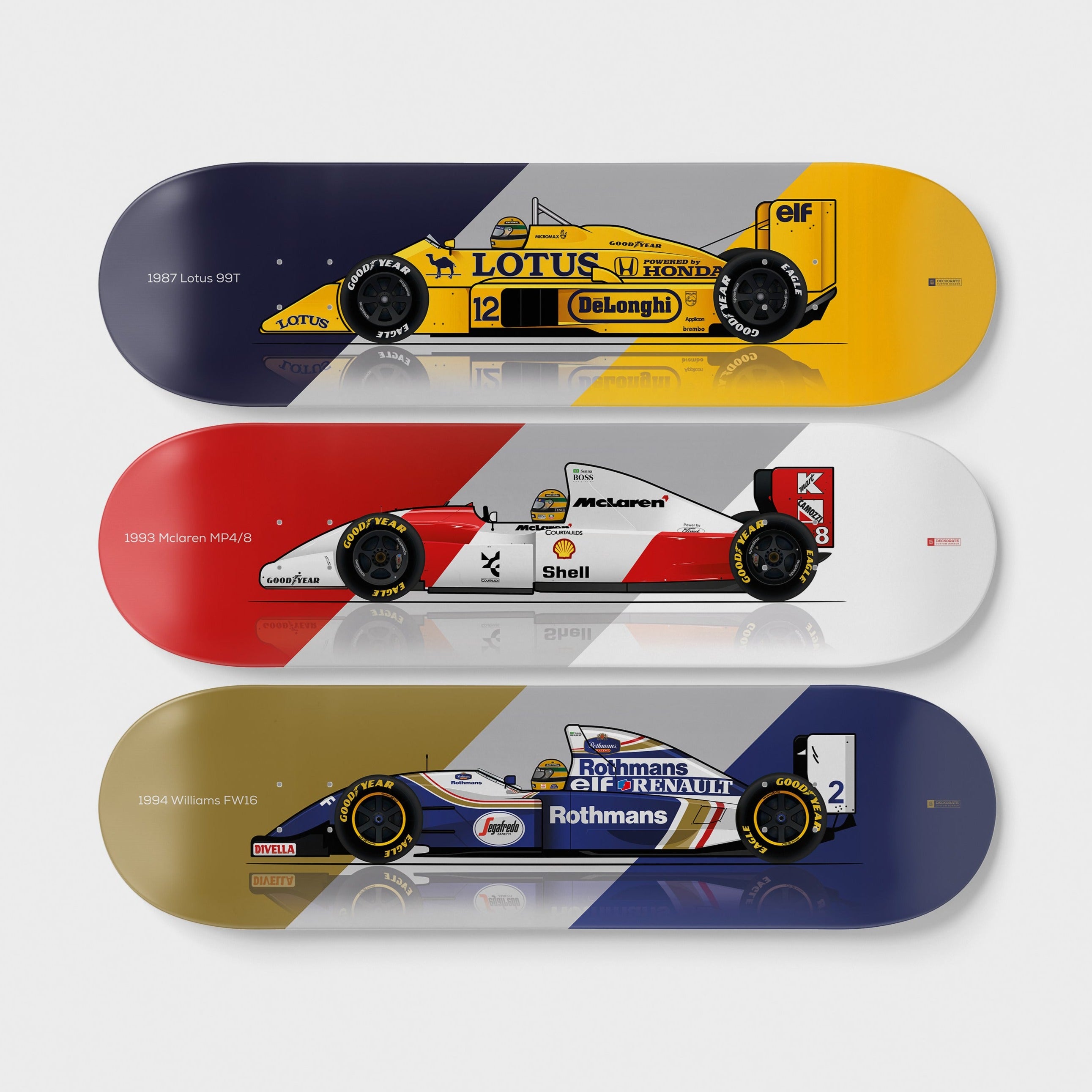
The Deckorate F1 collection covers both men across the cars that defined them.
The Senna 3-pack covers three chapters of his career: the Lotus 97T from his first season in 1985, the McLaren MP4/4 that won 15 of 16 races in 1988, and the Williams FW16 he drove in the 1994 season that ended at Imola.

The Schumacher 3-pack traces his journey from the Jordan 191 at Spa in 1991, his debut race, where he qualified seventh on a circuit he had never driven, through the Ferrari years that produced five consecutive championships.