The Martini Racing Livery: How Three Stripes Became Motorsport's Greatest Design
Some liveries win races. A few win races and then outlive every car that ever wore them. The Martini stripes belong in that second group. Dark blue, light blue and red on white, and you know exactly what you are looking at before you can even read the model badge.
It started at Hockenheim in December 1970, when the colours were revealed on a Porsche 917 built for the 1971 World Sportscar Championship. Within months the livery had its defining moment: a 917K took overall victory at Le Mans in 1971, and the stripes were forever tied to winning. The 917 was already one of the most fearsome cars of its era. Wrapped in Martini colours, it became something people still draw from memory.
What makes the design work is restraint. Two shades of blue and one red, laid over white or bare silver. No gradients, no clutter, no noise. The stripes follow the bodywork rather than fighting it, narrowing over the doors and stretching across the fenders. On a low, wide sports car the effect is unmistakable. It is the same logic that makes a deck work on a wall: let the shape carry the design, and keep everything else quiet.
Porsche gave the livery its first chapter, and the pairing ran deep, from the 917 to the 935 that dominated the late 1970s. If you want that era on your wall, the Porsche 964 Martini carries the colours into the air-cooled 911 that a whole generation grew up worshipping. White body, the stripe laid across the flank, sat on the right wheels. It is one of those combinations that looks correct the moment you see it.

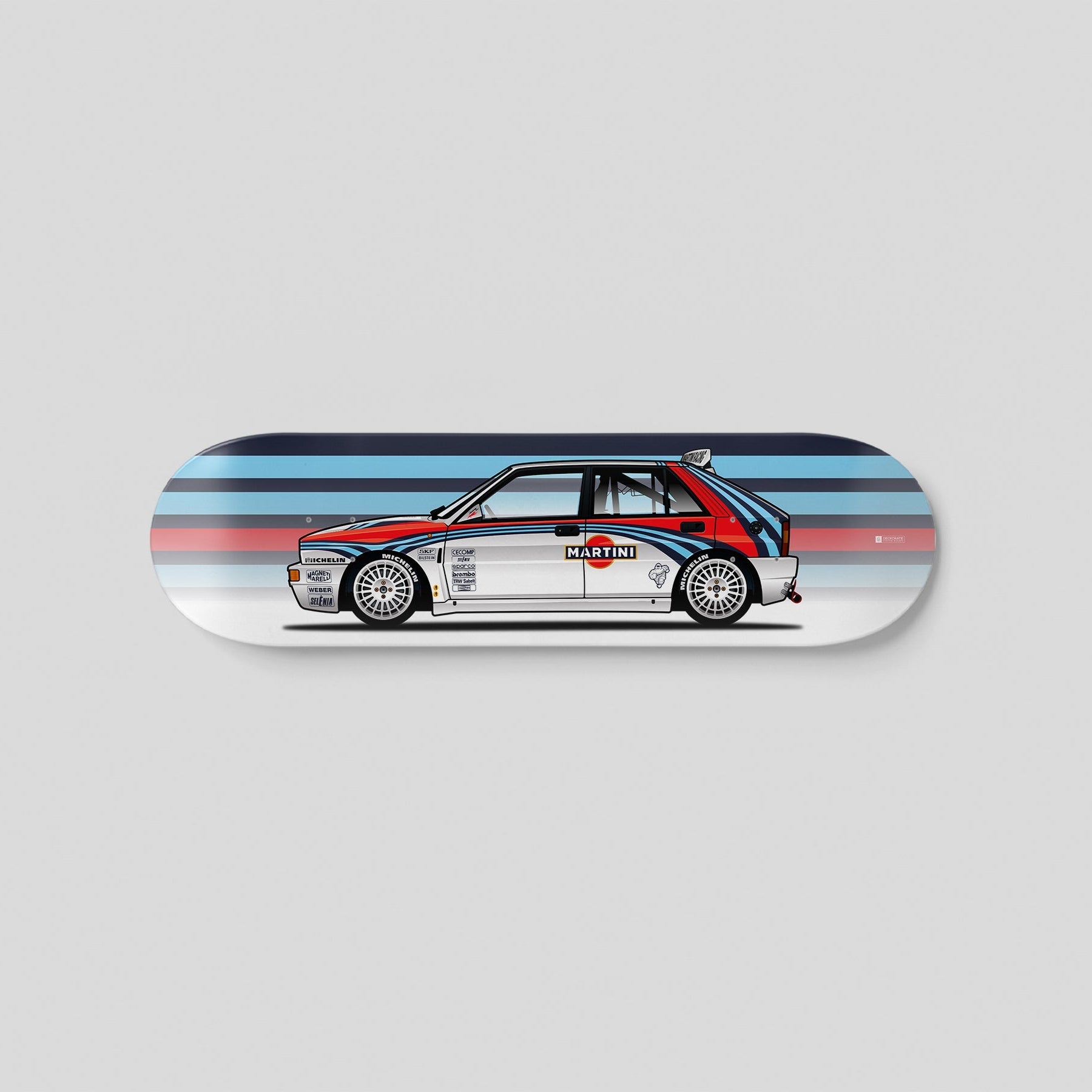
Then came the rally chapter, and this is where the livery became legend for a different crowd. From 1982, Martini put its stripes on Lancia, and the partnership rewrote rallying. It began with the Group B 037, the last rear-wheel-drive car to win a World Rally Championship manufacturers' title, and ran through the brutal Delta S4 and into the Group A era with the car that defined it: the Delta Integrale. Six constructors' titles came out of that Lancia relationship. No livery and marque combination in rally history is more sacred.
That Integrale is the heart of the story, and the Lancia Delta Integrale Evo in Martini livery puts it on maple exactly as it should be. White, red and blue, the stripe wrapping the arches of the boxiest, most purposeful rally car ever homologated. Hang it next to the 964 and you have both halves of the Martini story on one wall: the German endurance icon and the Italian rally king, united by three stripes and nothing else.

The colours have appeared elsewhere over the decades, on Formula 1 cars, on touring cars, on the odd special edition road car. But the two that matter most, the ones every enthusiast pictures first, are the Porsche and the Lancia. That is why they sit at the centre of this collection.
A great livery is a piece of design that happens to go racing. The Martini stripes are the clearest proof there is. More than fifty years after Hockenheim, they still stop people in their tracks. On a wall, drawn down to the last stripe and rim spoke, they do exactly the same thing.